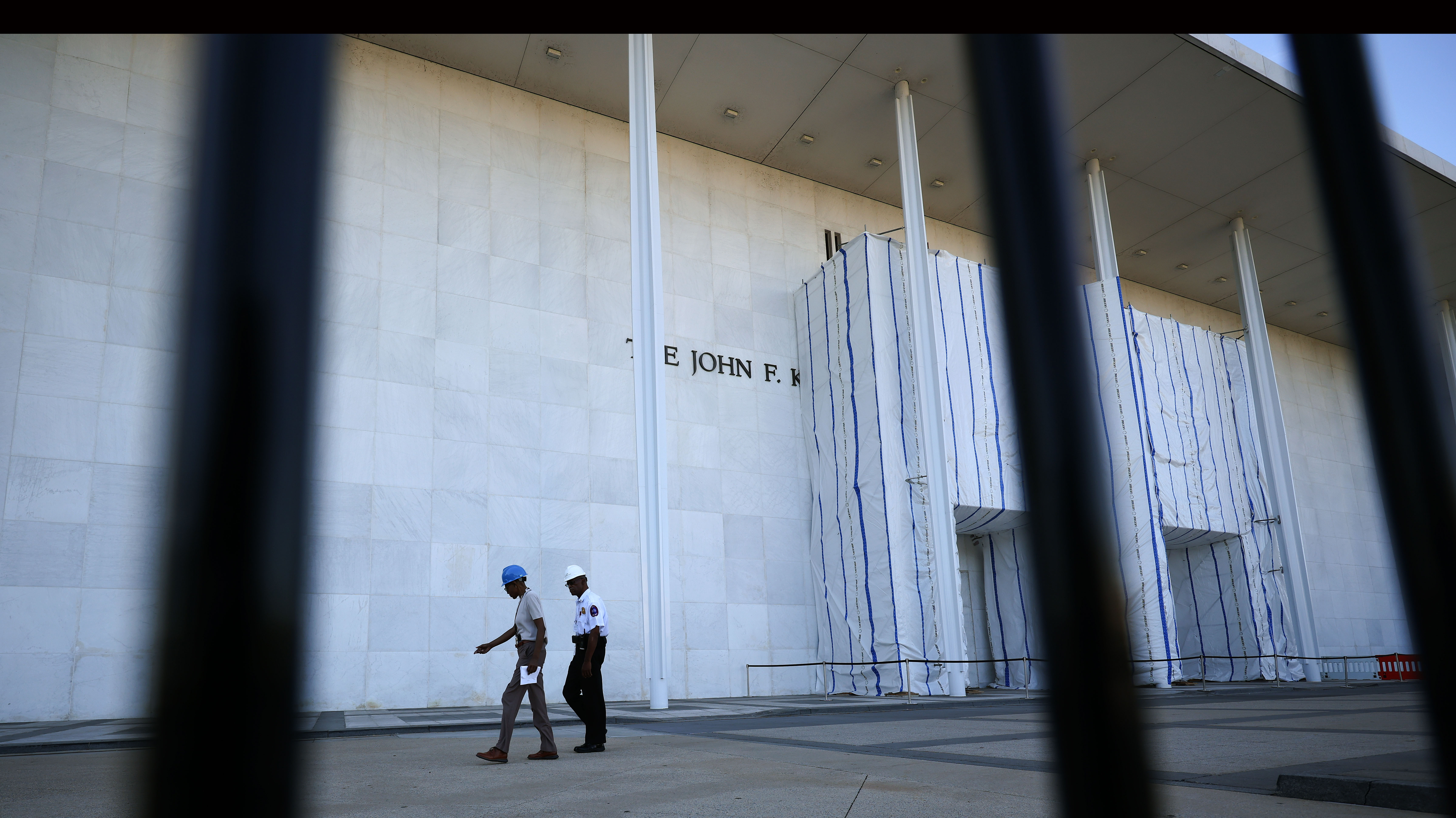
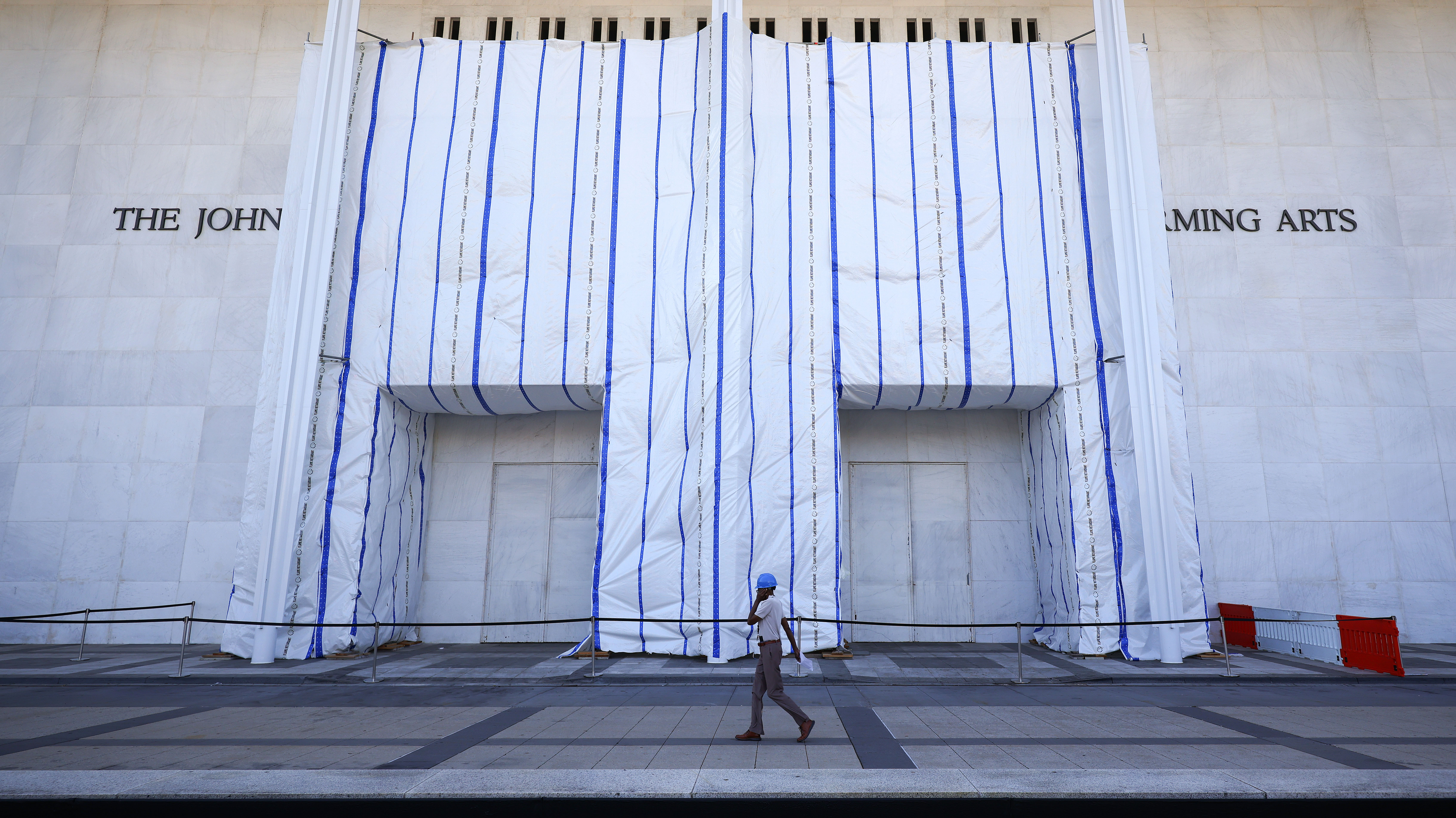
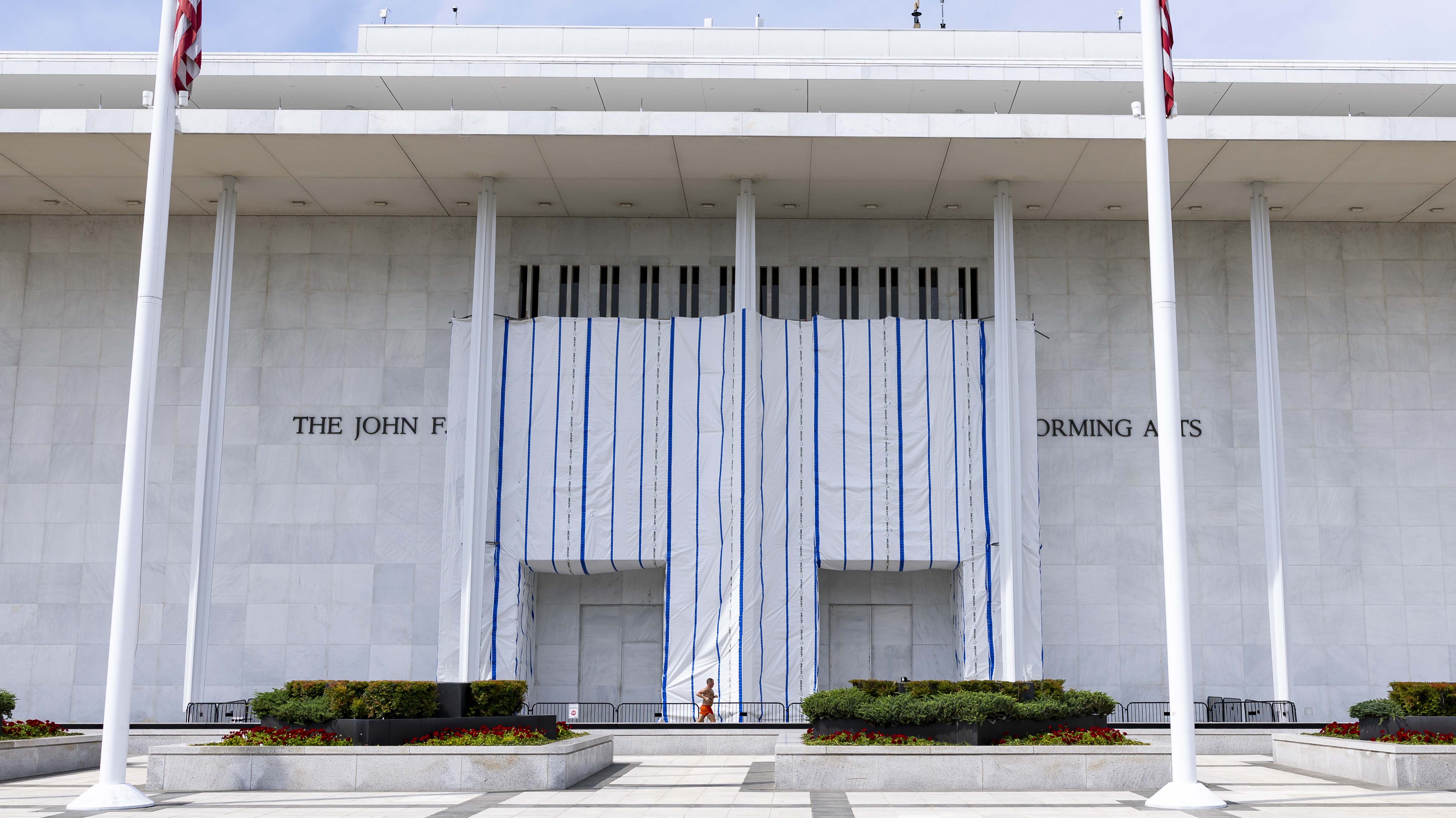
Workers walk past newly installed fencing outside the John F. Kennedy Memorial Center for the Performing Arts on Sept. 16, 2026, in Washington, DC. The new fencing composed of “bike rack” and barricade material was installed a day after the Kennedy Center Board voted to close the venue for repairs. (Win McNamee/Getty Images)
(WASHINGTON) -- Several hundred activists are expected to gather at the Kennedy Center on Friday in opposition to President Donald Trump's attempted takeover of the presidential memorial and threats that he will close and demolish it.
Activists are expected to gather Friday evening to link hands and form a human chain outside the Washington venue, demanding Trump be removed as its chairman for failing to protect and manage it. Trump installed himself as chairman of the Kennedy Center last year after removing its previous leadership and replacing board members with his own appointees.
"The demonstration opposes the recent sudden closure of the facility, the installation of security fencing, and political efforts to alter or demolish portions of the presidential memorial," the group said on its website.
The Hands Off the Arts organization behind the rally and protest said they expect hundreds of people to gather on the center's steps for musical performances, testimonials and speeches before forming a human chain around the building. The group has held various protests outside the performing arts venue this year.
Earlier this week, Trump said the Kennedy Center could be "ripped down" if his administration doesn't receive recognition on the performing arts center as tensions over his name being removed from the venue mount.
"I think that the Trump administration should certainly have recognition. Because frankly, if we don't do that, it's going to close. It'll end up being ripped down," the president told reporters.
The activist coalition said its goal is to reclaim the Kennedy Center from "authoritarian overreach and protect other arts and cultural institutions from similar fates," according to the group's website.
"This is not the Kennedy Center you know and love. It’s not the Kennedy Center you deserve," the group said on its website. "We know what the Kennedy Center is meant to be, and can be again -- the nation’s cultural center, active with life, joy, and incredible art."
The group says it formed after leadership changes at the Kennedy Center in recent months.
A federal judge on Thursday ordered the Kennedy Center to provide 30 days' notice before making any major physical changes to the building, including demolishing it as Trump has threatened.
U.S. District Judge Christopher Cooper issued the order after lawyers for Democratic Rep. Joyce Beatty, an ex officio member of the board, cited Trump’s warning that the center could be "ripped down" and submitted photographs appearing to show the Trump examining a placard labeled "Kennedy Center DEMOLISHED" on Wednesday night. The photos were taken Wednesday night through a cabin window on Air Force One.
The venue "cannot install memorials for President Trump or anyone or anything else at the Kennedy Center without Congress’s blessing," Cooper ruled.
The judge earlier this week ruled that Trump's name could not be added to the center's exterior without congressional approval. The board previously placed his name on the facade, and removed it in June after an earlier ruling.
Trump has argued that the center is in poor condition and requires substantial government support to remain open.
"It's in very, very bad shape, very dangerous shape," Trump said Wednesday. "You see steel falling down. You see plaster falling off ceilings. You see a lot of dangers."
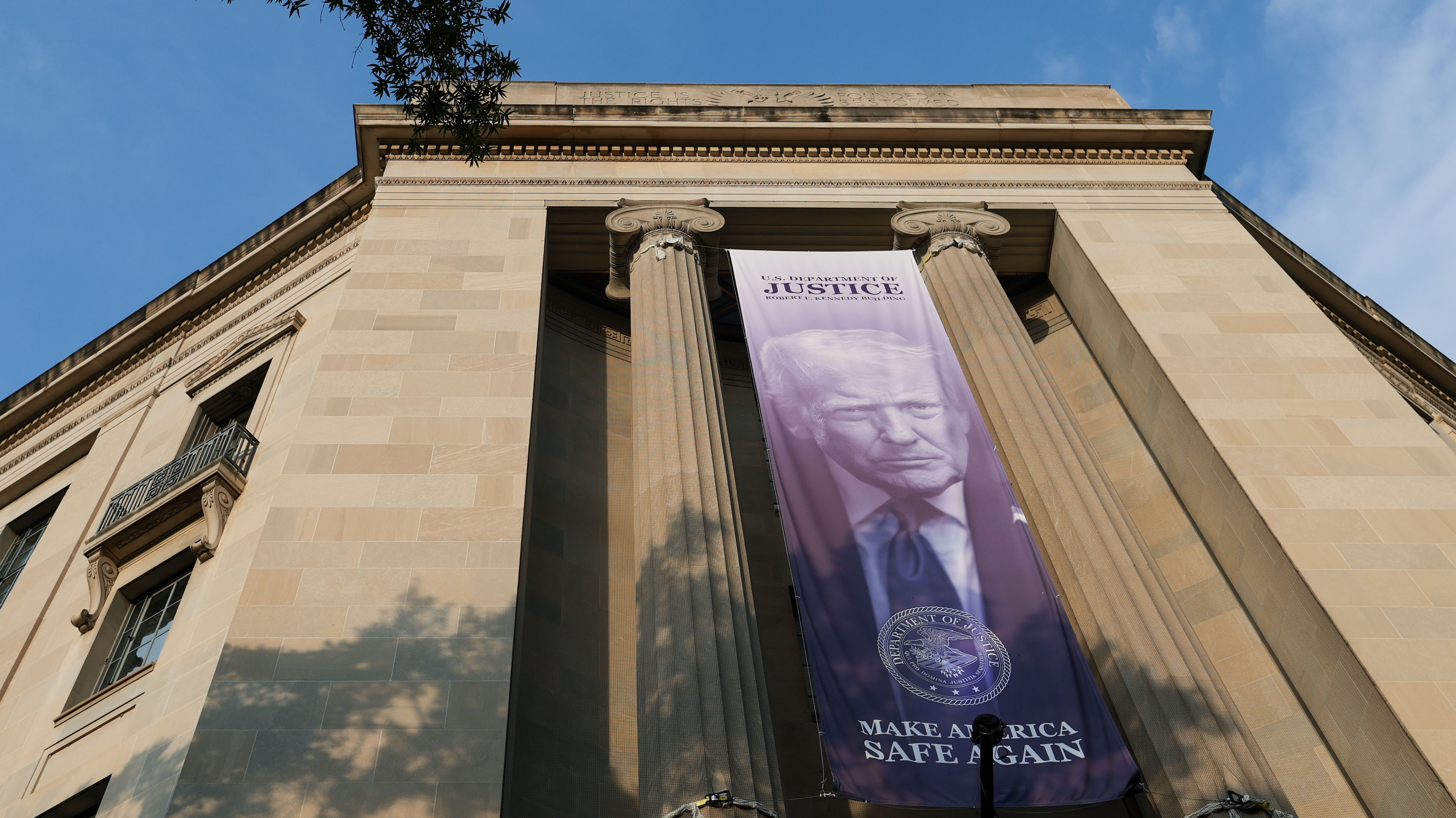
The U.S. Department of Justice Building on Aug. 17, 2026, in Washington, D.C. (Anna Moneymaker/Getty Images)
(WASHINGTON) -- A federal judge overseeing a lawsuit against the Justice Department said at a hearing Friday that she remains skeptical that the Trump administration won't move forward with improperly compensating allies of President Donald Trump who were prosecuted under the Biden administration, despite the DOJ's repeated statements that the $1.8 billion "Anti-Weaponization Fund" is dead.
U.S. District Judge Leonie Brinkema, who is overseeing a lawsuit filed in May that sought to permanently block the fund, pointed to recent statements from top administration officials that she said suggests payments are still on the table for people like anti-abortion protesters convicted under the FACE Act and rioters who attacked the Capitol on Jan. 6, 2021.
"Unfortunately there's been too much talk from members of the administration," Brinkema said in a hearing Friday in federal court in Virginia. "The issues that underlie this case are still alive and kicking in my view."
Brinkema's statements throughout the hearing leave the door open for her to reject an effort by the Justice Department to dismiss the lawsuit brought by a range of plaintiffs who claim they could face potential harm if settlement payments are doled out to Trump's allies.
At one point, Brinkema suggested that a potential remedy would be the appointment of an independent monitor to oversee payments out of the DOJ's Judgement Fund, which is typically the method used across administrations to dole out legal settlements with limited requirements for transparency.
Brinkema, in raising that hypothetical, said that the current Justice Department operates under a "somewhat coerced" state, with President Trump and the White House effectively eliminating the independence of the Justice Department that was established in the aftermath of the Watergate scandal.
Such a monitor could bring "independent oversight and offer proper unbiased evaluation" to claims by Trump's allies that they were actually victims of government "weaponization," Brinkema said -- though she noted such an appointment would only likely come after the lawsuit was fully resolved.
A DOJ attorney in court for Friday's proceedings repeatedly urged Brinkema to dismiss the lawsuit, citing Attorney General Todd Blanche's statements under oath that the Anti-Weaponization Fund was no longer moving forward.
During the proceedings, Brinkema repeatedly pointed to the recent ruling by the federal judge in Florida who oversaw Trump's lawsuit against the IRS that was the genesis of the settlement that resulted in the brief establishment of the Anti-Weaponization Fund and an agreement that effectively immunized President Trump and members of his family from audits of their past tax returns. Judge Kathleen Williams, who oversaw the IRS lawsuit, accused the DOJ of engaging in collusive behavior with Trump's personal lawyers and abusing her court to give the settlement legitimacy.
Brinkema said Williams' ruling was "very problematic" for the government and gave credence to the views that Blanche's statements under oath that the fund was "dead" couldn't necessarily be taken at face value.
"I keep on saying this over and over again, but I'm happy to say it one more time," Blanche said at a press conference last month in response to a question from ABC News. "I have testified under oath that it's dead. I have testified in front of the House where I wasn't under oath where I said it was dead. I have answered questions after my hearing where I said that it was dead, I have rescinded the order that that set up the weaponization fund, which means that it does not exist."
"The real concern that I think lurks is this concept of taxpayer money being used to promote political viewpoints," Brinkema said during Friday's hearing. "I think the 'Anti-Weaponization Fund' -- that entity, is gone. But is there a functional equivalent of that going on?"
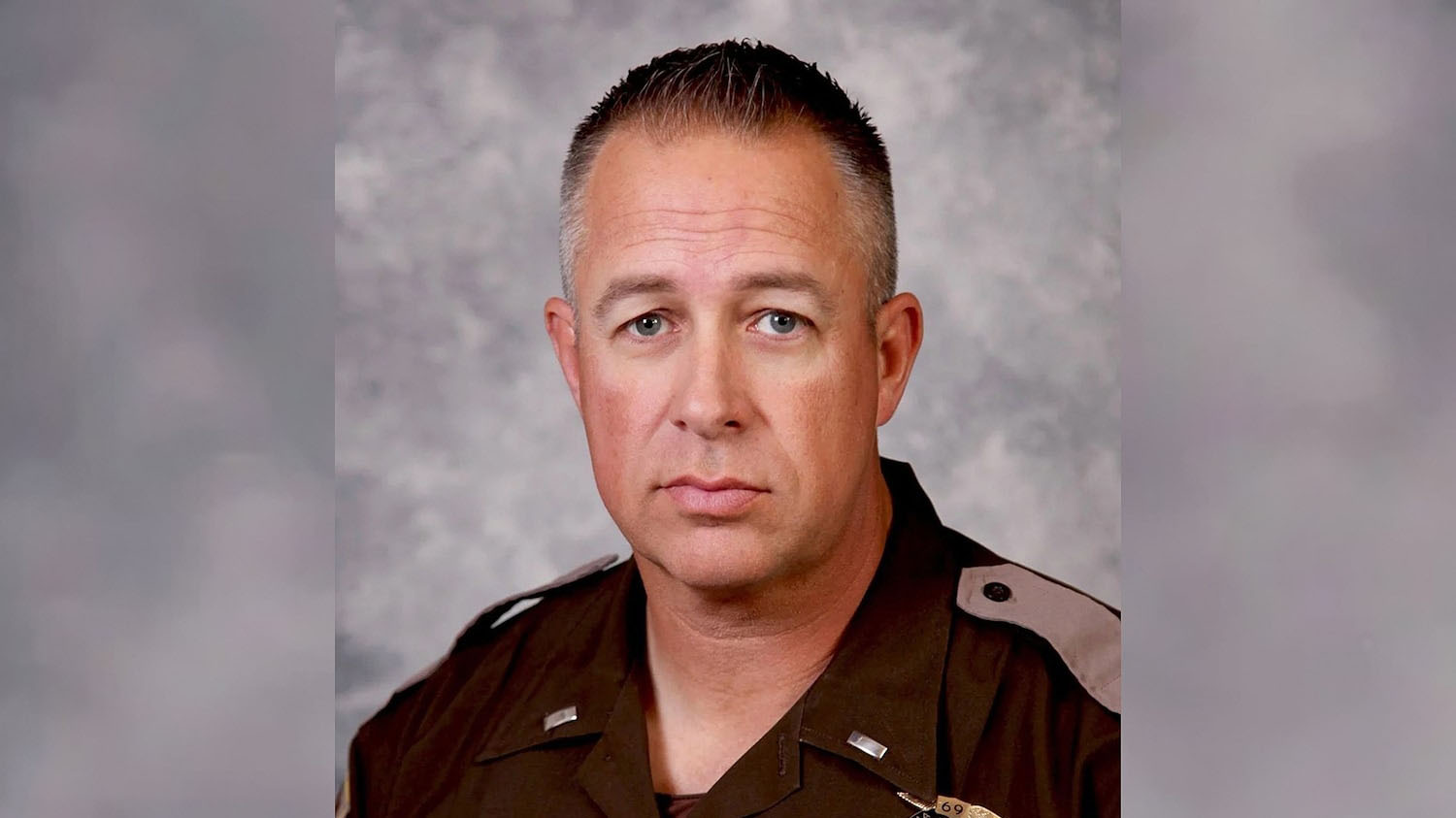
President Donald Trump previously nominated Lance Schroyer, a longtime law enforcement officer from Oklahoma, to be his nominee for ICE director. (Oklahoma Highway Patrol)
(WASHINGTON) -- The White House has withdrawn the nomination of Lance Schroyer to be the next Immigration and Customs Enforcement (ICE) director, according to a notice posted on the White House website Thursday.
The agency has not had a Senate-confirmed director since 2017. Former acting ICE Director Todd Lyons retired in May and David Venturella, a former private prisons executive, has been running the agency since then.
Schroyer, a former Oklahoma state trooper and close confidant of Homeland Security Secretary Markwayne Mullin, was nominated in June but faced pushback from the president's base and Democrats over what they said was his lack of qualifications for the job. His nomination had stalled in the Senate Homeland Security and Governmental Affairs Committee.
The White House did not give a reason for withdrawing Schroyer's nomination. ABC News has reached out to the White House for comment.
ICE's more than $75 billion budget is the largest of any law enforcement agency in the country.
The agency has become a focal point of the president's second-term deportation push and the Republican-controlled Congress has given the agency the resources to carry out the administration's agenda.
ICE has come under scrutiny during its push to deport those in the country illegally for what some Democrats say are heavy-handed tactics and a rush to hire candidates that weren't qualified for the job.
In nominating Schroyer in June, Trump touted his 29 years of service as a law enforcement officer in Oklahoma and said Schroyer will enforce the administration's crackdown on undocumented immigrants.
Schroyer, who served in the Marine Corps, is currently a senior adviser to Mullin, a former senator from Oklahoma. Schroyer was Mullin's pick to lead ICE, a source with knowledge of the decision told ABC News.
Workers walk past a recently closed John F. Kennedy Memorial Center for the Performing Arts on Sept. 16, 2026, in Washington, D.C. (Win McNamee/Getty Images)
(WASHINGTON) -- A federal judge on Thursday directed the Trump administration to provide 30 days' notice of any changes in the Kennedy Center's renovation plans, "including but not limited to any 'demolition' of the Center's main building," as the jockeying over the future of the performing arts center continued.
U.S. District Judge Christopher Cooper made his ruling the afternoon after President Donald Trump was photographed looking over a placard that appeared to include the words "Kennedy Center DEMOLISHED" over what appeared to be an image of a demolition.
In a federal court filing Thursday morning, Kennedy Center executive director Matt Floca said the current closure of the main building is only "temporary," set to last for seven days, and will be reevaluated on a weekly basis.
Judge Cooper, in his ruling, ordered the administration to update him on the status of the "'temporary closure' and emergency repairs" by next Wednesday.
The ruling came as Cooper turned down a request from Ohio Democratic Rep. Joyce Beatty for an emergency hearing in the case, citing the morning's announcement.
The photos of Trump examining the placard were taken Wednesday night through a cabin window on Air Force One by Agence France-Presse photojournalist Brendan Smialowski, who was acting as the pool photographer for White House coverage, as Trump landed at Joint Base Andrews.
It was not immediately clear what the full contents of the placard were or how they were generated. The published images don't show the entire placard and the word that appears to be "DEMOLISHED" was not entirely visible, cut off as "DEMOLIS."
ABC News has reached out to the White House for comment.
The images were published on Wednesday evening, shortly after the president said the performing arts center could "close" or be "ripped down" if his administration doesn't receive recognition on the performing arts site.
"I think that the Trump administration should certainly have recognition. Because frankly, if we don't do that, it's going to close. It'll end up being ripped down," the president told reporters on the tarmac in North Carolina.
Congress last year appropriated $257 million for needed renovations. But Trump said in a social media post on Tuesday that those renovations will not take place unless his name is again added onto the building.
His name had been added to the center's exterior after the Trump-controlled board voted in December to rename the building the "Trump-Kennedy Center."
Judge Cooper ruled in May that Trump's name had to come down. Cooper wrote in a decision that the center's rebranding violated the law. He ordered that Trump's name be removed from the building within two weeks.
In July, a panel of D.C. Circuit appeals court judges rejected a request by Trump and fellow members of the center's board to stay the court's order that Trump's name be removed from the building.
Last month, the Kennedy Center board members -- who Trump last year replaced with his allies -- voted to close the famed cultural institution for a two-year renovation. They voted on Tuesday to close the building immediately.
Also on Tuesday, Cooper issued a written order blocking any attempt to add Trump's name to the building, concluding it violated a previous court order and congressional statute.
"Simply put, Defendants cannot install memorials for President Trump or anyone or anything else at the Kennedy Center without Congress's blessing," Cooper wrote. "The board resolution bucks a federal court order and a statute Congress enacted."
ABC News' Karen Travers, Michelle Stoddart and Devin Garbitt contributed to this report.
A model of President Donald Trump's proposed arch next to models of the Washington Monument and the U.S. Capitol Building on a table at a public meeting of the Commission of Fine Arts, April 16, 2026, in Washington. (Andrew Harnik/Getty Images)
(WASHINGTON) -- The Trump administration acknowledges that the proposed construction of a 250-foot triumphal arch along the Potomac River at the foot of Arlington National Cemetery will cause "adverse effects" on the setting and views along the river -- but it says those impacts "cannot be fully avoided" because the arch's location is "central to the undertaking."
The acknowledgment is contained in a document that has been sent by the National Park Service to four historic preservation and planning agencies in the Washington area, seeking their agreement with park service's plans to mitigate the adverse effects.
Those efforts include monitoring construction vibration and controlling noise, an archeological study and various planned "improvements" to the parkland, including new walkways, curbs, lighting and plantings, according to the document.
Earlier this month, attorneys for a group of Vietnam War veterans who have sued to block construction of the arch, asked a federal judge to issue a temporary restraining order to prevent the administration from moving forward with excavation work on the project. The veterans suing over the arch have argued it would obstruct views of Arlington National Cemetery and can't be built without congressional authorization.
Federal rules call for agreements like this to be reached with a state's historic preservation office or a tribal nation when there's the potential for a project to "diminish the integrity" of a historic property. Memorial Circle, the planned site for the arch and a roundabout near the entrance Arlington National Cemetery, is a historic property listed on the National Register of Historic Places.
While the law requires consultation and an effort to minimize potential harms -- "to the maximum extent possible" -- agreement with state officials does not appear to be a requirement for a federal project at a historic site to continue.
The document circulated by NPS to historic preservation officials in Virginia and D.C. says that Memorial Circle "is located within a highly sensitive historic and commemorative landscape," and that the arch at that space would affect the "setting, design, feeling, association, spatial organization, circulation, and contributing views and vistas" of the location.
Renderings of the arch show a 250-foot structure -- more than twice as tall as the nearby 99-foot Lincoln Memorial -- with an inscription reading "One Nation Under God" and at its top, a gold statue of Lady Liberty with outstretched gold wings. Four golden lions sit at each corner of the arch's base, renderings showed.
The administration said in the document that the location is "central to the undertaking" and the arch can't be placed elsewhere because "relocation outside Memorial Circle would constitute a materially different undertaking."
Word of the agreement was first reported by The Washington Post.
Trump has said called the arch a "wonderful addition to the Washington D.C. area," saying in a social media post earlier this year that it will be the "GREATEST and MOST BEAUTIFUL" of structures "anywhere in the world."
The arch received initial approval in July from the National Capital Planning Commission, a federal agency led by Trump's hand-picked appointees, despite hours of public testimony against the project.
The arch still needs final approval from the National Capital Planning Commission. Several Democratic lawmakers say that the arch violates the Commemorative Works Act, which requires congressional approval for memorials on federal land in or near D.C.
An Interior Department spokesperson said it will "follow all laws and regulations" around the arch construction.
"Throughout the consultation process, Interior has received over 100,000 public comments, has accepted dozens of organizations as consulting parties, and has extended comment periods to allow for more robust discussion," the spokesperson said in a statement to ABC News.
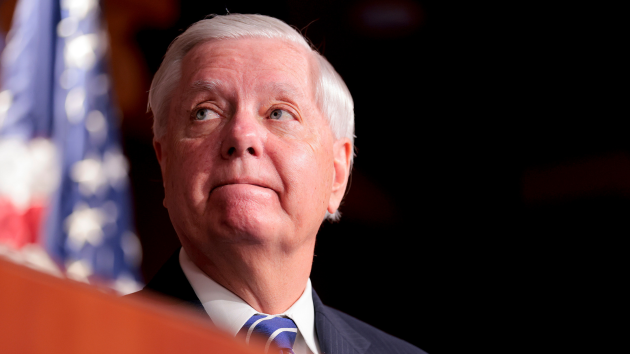
U.S. Sen. Lindsey Graham (R-SC) looks on during a press conference at the U.S. Capitol on April 27, 2026, in Washington, DC. (Photo by Heather Diehl/Getty Images)
(WASHINGTON) -- The House passed a Russia and Iran sanctions bill championed by the late Sen. Lindsey Graham Wednesday night -- sending the measure to President Donald Trump's desk for his signature.
The final tally was 262-159.
Seven Republicans -- Reps. Thomas Massie of Kentucky, Andy Harris of Maryland, Ralph Norman of South Carolina, Keith Self of Texas, Tom McClintock of California, Chip Roy of Texas and Warren Davidson of Ohio -- voted against the measure.
The bill's passage comes about two months after Graham's sudden death.
The package would impose primary and secondary sanctions on Russia and other countries that support Russia in its invasion of Ukraine. The sanctions target Russian political officials and oligarchs, banks and financial institutions, and the Russian shadow fleet, according to the bill.
The legislation also allows for the president to impose tariffs but limits the scope of those tariffs to the five largest importers of Russian crude oil or gas and the top five countries that aid Russia's energy sanctions evasion.
It also includes a provision to prevent a lapse in sanction authority that restricts funding for Iran's energy and weapons sectors.
In a statement on social media, Sen. Darline Graham, R-S.C., who was appointed to fill her late brother's Senate seat and is now running for a full term, celebrate the measure's passage.
"Today is a monumental day for peace," she wrote in the post on X. "This legislation was deeply important to my brother, Lindsey, and I'm grateful that it achieved such a wide coalition of support on the House floor. I am committed to achieving a peaceful resolution to the war in Ukraine, and I'm confident that this legislation will pave the way."
The vote split Democrats -- 58 voted in favor while 152 voted against.
Top House Democratic leaders including Leader Hakeem Jeffries explained why they voted against the sanctions bill, saying it “gives extraordinary power to Donald Trump.”
“It allows him to waive the sanctions contained in the bill, while giving him new, expansive tariff authority to continue his failed global trade war that is causing costs to skyrocket for working families across America," they said. "Sadly, the White House is willing to risk Ukrainian lives and American livelihoods instead of working to actually hold this rogue Russian regime accountable for its illegal war."
Earlier this week, several Democrats, including Reps. Gregory Meeks, Richard Neal and Don Beyer, voiced concerns with the bill but expressed their staunch support for Ukraine.
The Senate approved the measure last month with overwhelming bipartisan support by a vote of 86-11.
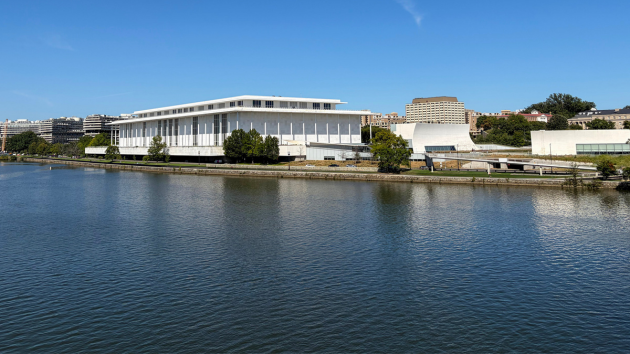
The John F. Kennedy Center for the Performing Arts, seen from the Theodore Roosevelt Bride in Washington, D.C. September 15, 2026. (Astrid Riecken For The Washington Post via Getty Images)
(WASHINGTON) -- President Donald Trump said on Wednesday the Kennedy Center could "close" or be "ripped down" if his administration doesn't receive recognition on the performing arts center as tensions over his name being removed mount.
"I think that the Trump administration should certainly have recognition. Because frankly, if we don't do that, it's going to close. It'll end up being ripped down," the president told reporters on the tarmac in North Carolina.
Trump claimed that the Kennedy Center was a "mess" without his intervention and "has lost 10s of millions of dollars, even hundreds of millions of dollars," comparing it to New York's Carnegie Hall.
The president's comments come after a federal judge on Tuesday blocked the performing arts center's board from adding a tribute to Trump on the building or site. He responded by saying he wouldn't spend congressionally approved funding for the center's renovation unless the building also bears his name.
Congress last year appropriated $257 million for the renovation.
About an hour after the judge's ruling Tuesday, the board, which is controlled by Trump appointees, voted to close the center immediately for renovations, citing safety concerns after a piece of plaster from the ceiling of the grand foyer fell during a heavy rainstorm earlier this month.
On Tuesday, Rep. Joyce Beatty, D-Ohio, said Trump “threw a tantrum because he lost in court” when discussing the Kennedy Center meeting.
“He wasn't pleased with it. He was very explicit with his words, and I responded equally as explicit. He is in contempt of court for what he's doing now in trying to just simply go over and close the Kennedy Center and to have people leave the center,” Beatty told reporters on the House steps Tuesday night.
Beatty said “there was a heated debate” during the meeting.
On Wednesday, fencing was seen being installed around the main building's entrance.
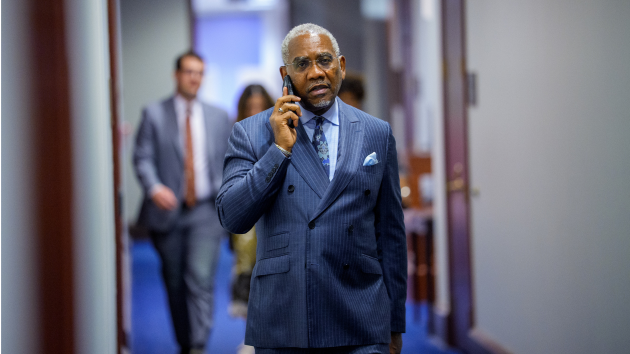
Rep. Gregory Meeks (D-NY) arrives for a Democratic caucus meeting on Capitol Hill on September 1, 2026 in Washington, DC. (Photo by Andrew Harnik/Getty Images)
(WASHINGTON) -- Democratic lawmakers are pushing a bill to disapprove of a nuclear cooperation agreement struck between the United States and Saudi Arabia in a bid to strike down the proposal during a three-month period of congressional review.
Democratic Reps. Gregory Meeks, the top Democrat on the House Foreign Affairs Committee, along with Brad Sherman, John Garamendi and Don Beyer introduced a Joint Resolution of Disapproval on Wednesday, shortly before lawmakers left Washington to return home ahead of midterm elections. A vote could come in November, after the midterms.
Without a two-thirds vote, President Donald Trump could veto Meeks' bill and the nuclear deal would take effect as it is written.
The nuclear deal, known as a 123 agreement, paves the way for American industry to collaborate on tens of billions of dollars of nuclear energy projects in the kingdom in what the administration says is a sign of deepening ties between the U.S. and Saudi Arabia.
The agreement has raised concerns around the proliferation of technologies that could support a Saudi effort to weaponize nuclear energy, security experts and members of Congress have said.
The terms of the agreement break from the so-called "gold standard" for nuclear deals, by which countries allow international inspectors widespread access to facilities that could support nuclear development. Inspectors are also allowed access to undeclared sites -- activities that could involve research that would contribute to nuclear energy.
The U.S.-Saudi deal instead includes a narrower agreement that would limit inspections, administered by the International Atomic Energy Agency, to only declared nuclear sites.
The text of the agreement, which has been released publicly by the administration, establishes a joint study between the two countries on the feasibility of an enrichment facility on Saudi Arabian soil. An additional study could open the door to enrichment of uranium of up to 20%.
Kelsey Davenport, the director for nonproliferation policy at the Arms Control Association who has reviewed the text, said that study was described "vaguely" in the signed agreement.
Enrichment to 20% "poses a more significant risk because enriching to that level constitutes the majority of work necessary to enrich to weapons-grade levels, or 90%," Davenport said. "The United States has repeatedly, and rightly, raised concerns about Iran previously enriching to the 20 percent level."
Saudi Arabian Crown Prince Mohamed bin Salman, the kingdom's de facto leader, has in the past said his government would seek a nuclear weapon if Iran managed to acquire one.
In its communication to Congress on Aug. 27, the Trump administration acknowledged the Crown Prince's "concerning public statements."
Secretary of State Marco Rubio, defending the deal in July, said that Saudi Arabia could have turned to an American adversary, like China or Russia, had the U.S. not been prepared to sign the nuclear agreement.
"We live in a new era," he said. "There are competitors that we face, so we'll have to adjust individual deals to that reality. We're not the only show in town but we're the best show in town. But we want to be, we want to make sure that it's our companies they're picking."
In a letter to Rubio and Energy Secretary Chris Wright Wednesday, a group of lawmakers called for the administration to declassify two documents, or "side letters," which the White House said were part of the deal but could not be released.
The lawmakers, which included Republican Sens. John Kennedy Louisiana and Rand Paul of Kentucky, called for their release, adding they were "aware of no precedent for classifying and withholding the side letters, particularly when the stated purpose is peaceful nuclear cooperation."
A bill to strike down the Saudi deal, requiring a supermajority in the Republican-controlled Congress, is exceedingly unlikely. But lawmakers could also opt to pass a law that applies certain conditions to the nuclear agreement.
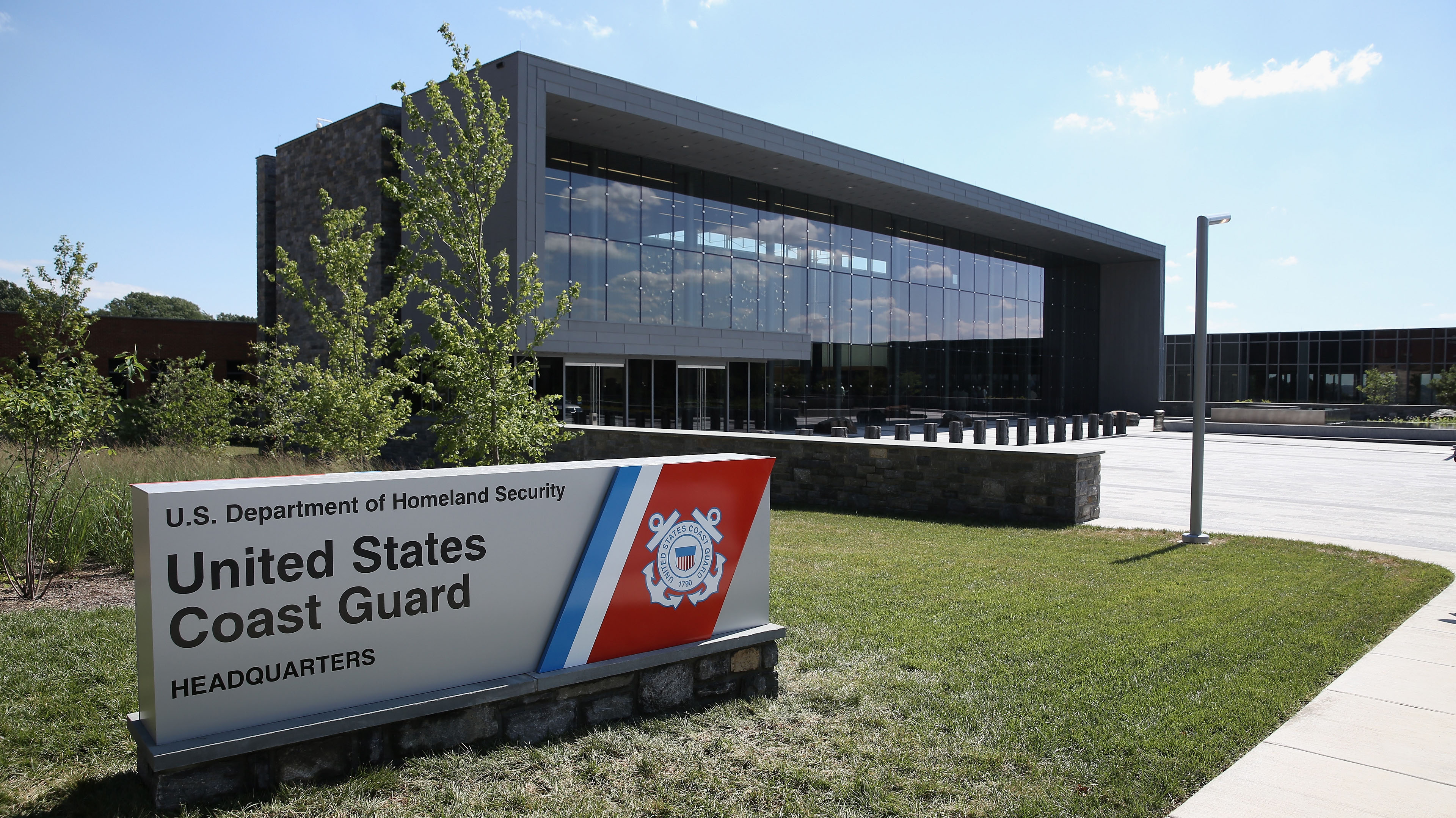
The U.S. Coast Guard Headquarters is seen July 29, 2013, in Washington, D.C. (Alex Wong/Getty Images)
(WASHINGTON) -- The Coast Guard and FBI are investigating after two oil tankers bound for the U.S. were hit with suspected cyberattacks last month, prompting American authorities to launch investigations into both incidents, sources told ABC News.
On Aug. 21, one of the tankers, described as a "foreign-flagged commercial vessel" was boarded by a "highly specialized team" of U.S. Coast Guard law enforcement officers, cyber protection members and an FBI cyber team in the Gulf of Mexico, according to a joint statement from both agencies.
"The measures were designed to ensure integrity of the vessel’s operational and information technology systems following indications that the vessel’s network were compromised by foreign cyber actors," the statement said.
That vessel was in the Strait of Gibraltar when it was hacked, according to sources, and lost communication for over 30 hours.
The joint statement said the ship's crew members cooperated with authorities and were "critical partners in helping to ensure the threats were mitigated" and concluded: "Currently, there are no reports of operational disruptions, vessel instability, physical danger to crews, or environmental impacts."
Sources told ABC News that another tanker that was hit by a cyberattack was boarded by U.S. officials on Aug. 24. to conduct a similar assessment.
Authorities are investigating the possibility that Iran or another actor -- seeking to exploit the ongoing conflict between Iran and U.S. -- was involved in attacks, according to the sources.
"Currently, there are no reports of operational disruptions, vessel instability, physical danger to crews, or environmental impacts," the joint statement released by the Coast Guard and FBI said.
Rep. Thomas Massie (R-KY) at the U.S. Capitol on Sept. 1, 2026, in Washington, D.C. (Chip Somodevilla/Getty Images)
(WASHINGTON) -- Outgoing Republican Rep. Thomas Massie seized the House floor for more than an hour Tuesday afternoon, launching a long-shot effort to impeach Defense Secretary Pete Hegseth stemming from his controversial administration over the Pentagon, including the war in Iran.
After sending a news release announcing his intent to impeach Hegseth, Massie quickly appeared on the floor where he stood for more than 67 minutes reading the sweeping 34-page resolution with eight articles of impeachment aloud.
"Secretary Hegseth has acted in a manner contrary to his trust as Secretary of Defense and subversive of constitutional government, to the great prejudice of the cause of law and justice, and to the manifest injury of the people of the United States of America," Massie read from the resolution, contending that Hegseth will "remain a threat to civilians and the laws of war, the integrity of United States diplomacy, and the Constitution if allowed to remain in office, and has acted in a manner grossly incompatible with his duties and the rule of law."
"Peter Brian Hegseth thus warrants impeachment and trial, removal from office, and disqualification to hold and enjoy any office of honor, trust, or profit under the United States," the resolution states.
The Pentagon responded to Massie's move, defending Hegseth in a statement to ABC News.
"Secretary Hegseth has been a transformative leader for the Department of War," Pentagon press secretary Kingsley Wilson said in the statement, later adding that the "entire Department is unified behind the Secretary’s vision and will continue working to put our warfighters and America first."
The articles of impeachment against Hegseth include ignoring laws that minimize civilian casualties, administering an "unlawful war" in Yemen, ordering extrajudicial killings, suppressing free speech and kidnapping a sovereign leader -- alluding to the U.S. capture of Nicolas Maduro early this year.
"Frankly, I was concerned that Mike Johnson would end Congress again, like shorten even our already truncated work period if he found out I was doing this. So I shared the idea with nobody," Massie said.
Massie, a conservative who has gained a reputation as a constitutionalist through his seven terms in the House, lost a primary earlier this summer after Trump endorsed his opponent.
It's unclear whether the vote will succeed, given Republicans' narrow majority in the House. Speaker Mike Johnson can lose two Republican votes before a third defection upsets the majority.
Unless GOP leaders change the floor schedule again, the House must hold a vote on the resolution within two-legislative days -- by Thursday, which would force Republicans to go on the record defending Hegseth ahead of the high-stakes midterm elections. GOP leaders could offer a motion to table the resolution or cancel the legislative session scheduled for Thursday to avoid the vote.
Speaking to reporters afterward, Massie explained that he introduced the articles of impeachment to place a "marker" in history on what he said was both President Donald Trump's and Hegseth's "illegal" conduct.
“Doing this wasn't predicated on whether it could succeed or not; there needs to be a marker in history,” Massie said. "The president has exceeded, and Secretary Hegseth specifically, in many ways himself, and sometimes directed by illegal orders from the president, they have exceeded all norms for rules of engagement for how you use or misuse our military, to take oil from another country, to kidnap a foreign leader, like somebody needs to put a marker in history, and that's what this is. Hopefully, it passes, and they can litigate this in the Senate.”
Massie also told ABC News he had waited until Tuesday because it presents the last possible time to force consideration of a privileged resolution Congress before the midterms.
Massie added he felt he had exhausted all other legislative ways to stymie the war in Iran as well as other foreign military interventions.
"Why today? Because Speaker Johnson has basically canceled the rest of Congress until the elections," Massie explained. "Two days from now is the end of our session before we go on recess, and there can be a vote within two days. So I had to do it today."
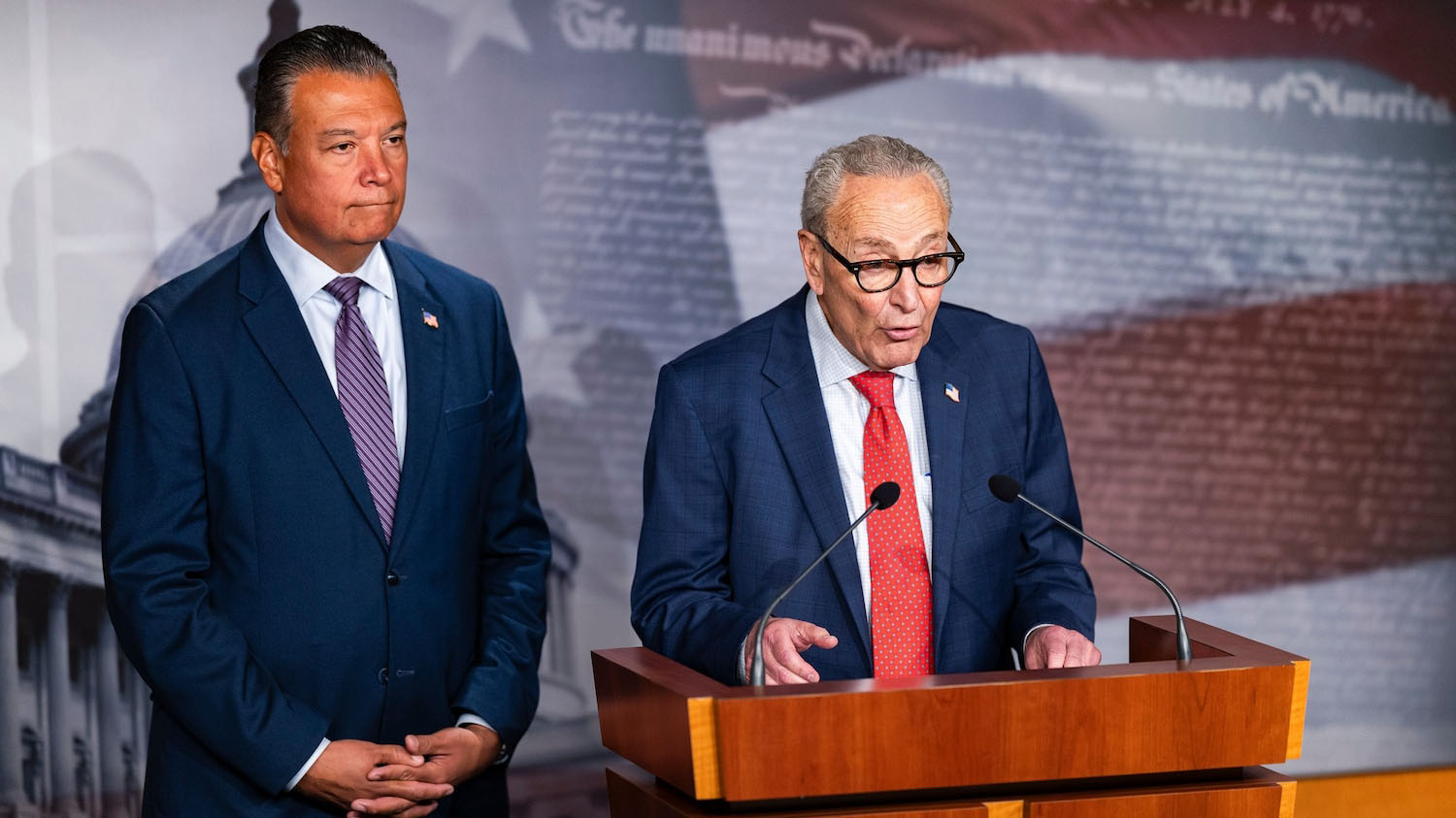
Sen. Alex Padilla listens as Senate Minority Leader Chuck Schumer speaks during a press conference at the U.S. Capitol, Sept. 14, 2026, in Washington. (Finn Gomez/Getty Images)
(WASHINGTON) -- The Department of Homeland Security has allegedly directed hundreds of agents to attempt to access voter rolls, even if they must “misrepresent themselves” to do so, and “fabricate” evidence of voter fraud ahead of the midterm elections, Senate Minority Leader Chuck Schumer and California Sen. Alex Padilla said Monday, citing what they said was information from a whistleblower.
“A DHS whistleblower warns that the department is pulling hundreds, hundreds of federal agents from national security rolls and sending them on a wild goose chase,” Schumer said at a press conference. “The goal: to try and prove Trump's sad, tired, and long-debunked election conspiracy theories."
"The length Trump will go to cheat, lie, and steal in this upcoming election are simply beyond the pale,” Schumer said.
“Apparently, agents are being commanded to violate state laws to access private voter information and fabricate law enforcement records as part of DHS's quote ‘Unlawful Voter Initiative,’" Schumer said, adding that DHS agents allegedly were "hunting for, or worse, manufacturing evidence of voter fraud claims."
The allegations and the whistleblower claims were enumerated in a letter from Schumer and Padilla sent Sunday to DHS Secretary Markwayne Mullin, in which the lawmakers demanded that DHS both explain the alleged actions and end them immediately.
The Department of Homeland Security has been ramping up efforts to look for voter fraud across the country through its investigative arm, Homeland Security Investigations (HSI), multiple sources familiar with the operation told ABC News earlier this month. The effort will include help from investigators from U.S. Citizenship and Immigration Services, the sources said.
"The Department accessed publicly available data from states’ voter rolls and cross referenced them with known aliens in our systems. It’s not rocket science; it’s an easy step to secure our elections,” DHS said in a statement to ABC News, in response to the whistleblower allegations.
“While ICE Homeland Security Investigations is not able to comment on any active investigations, HSI is actively rooting out and investigating election fraud wherever it can be found," the DHS statement further said. "We have repeatedly demonstrated that aliens can and do vote in our elections. Under President Trump, HSI is committed to restoring integrity to our election systems and ensuring that American citizens and only American citizens are electing American leaders.”
“They're even asking people to lie about their identities, so they can create this illegal scheme," Schumer said Monday of DHS agents' alleged activities. "We are weeks from the midterms. Americans should not have to fear being targeted by their own government because of how they're registered to vote.”
Padilla also highlighted the allegation, saying Monday that the whistleblower claimed DHS agents were "ordered to misrepresent themselves to access state voter systems, systems explicitly warning that accessing another voter's information without authorization is against the law."
Padilla further alleged the federal government is taking this route to access voter data because states such as his have not complied with demands for them to provide those records.
“But even more troubling is that when officers have raised questions about the legality of this initiative, they've reportedly been told to proceed anyway and promise that they won't be held quote personally liable,” Padilla said, citing the whistleblower claims. “That's what's coming from superiors in response to officers who are raising these concerns. If this effort is truly legal, then why does DHS leadership have to promise its officers that they're not going to be held liable? That says a lot.”
Padilla alleged the Unlawful Voter Initiative is “pretext” for the Trump administration to use “manufactured evidence to intimidate voters, to disenfranchise eligible Americans, and even undermine or challenge this November's election results.”
Ships are anchored in the Strait of Hormuz on Aug. 10, 2026, off the coast of Bandar Abbas, Iran. (Ali Saeedi/Getty Images)
(WASHINGTON) -- The war with Iran has cost the United States at least $38 billion through the end of July and is expected to further push inflation higher for American households, according to a nonpartisan Congressional Budget Office (CBO) assessment released Tuesday.
The CBO also warned that depleted weapon stocks could take a half decade or longer to rebuild, crippling the Pentagon’s ability to respond to another major conflict.
The assessment describes the financial and military consequences that will persist beyond the fighting, leaving the Pentagon with fewer weapons available for another major conflict while skyrocketing energy prices put pressure on household budgets.
The report notes that the Pentagon did not cooperate with the analysis or provide information requested by the Congressional Budget Office. The Pentagon did not respond to ABC News' request for comment on the report.
The CBO serves as Congress’ scorekeeper, providing lawmakers with independent estimates of federal spending and the costs of legislation. Its reports noted it relied heavily on public information.
The budget office’s estimate covers direct costs from the U.S. and Israel launching their campaign against Iran on Feb. 28 through Aug. 1, excluding expenses related to U.S. bases devastated by Iranian bombardments.
Munitions account for most of the spending. CBO projects another $2 to $3 billion in monthly costs, but says the bill could climb during sustained fighting.
Americans will also bear what could be mounting costs adding to already inflation rates, with projections estimating the consequences of the war to add roughly a half percentage point to the inflation rate early next year, meaning the costs of goods, housing and food will continue to rise, driven largely by climbing energy prices stemming from supply disruptions in the Middle East.
Depleted weapons stockpiles
The war has significantly depleted U.S. inventories of missiles and anti-air defense weapons, leaving fewer munitions available for another major conflict.
“The shortfall would become especially problematic if a conflict arose with an opponent whose arsenal included large numbers of ballistic and cruise missiles,” the CBO said in its report.
Those concerns predate the Iran war. A congressionally mandated commission warned in 2024 that the U.S. could largely exhaust its munitions inventories within three to four weeks of a conflict with China. Some critical weapons, including anti-ship missiles, could run out within days.
“Missile defense interceptors are in short supply because they have been produced at relatively low rates; thus, DoD’s inventory of such missiles was limited,” the CBO said in its report.
A Pentagon inspector general report on Monday came to the same conclusion that the massive expenditure of munitions against Iran has "resulted in strategic inventory shortfalls,” which revealed significant issues with U.S. force’s ability to resupply, as missiles take years to build. Persistent bottlenecks include the complexity and daunting list of materials and the recruitment of skilled labor to build them.
Patriot and SM-6 interceptors, used to shoot down incoming missiles and drones, cost roughly $4 million each, according to the CBO. THAAD interceptors cost about $12 million apiece, while more advanced SM-3 interceptors can cost roughly $28 million each.
The stark warning on munitions shortages comes just days after Adm. Brad Cooper, the war’s top commander, said in an interview on CBS Sunday that he’s not concerned about munitions depletions.
“We’re armed and ready for any contingency,” he said.
President Donald Trump on Monday dismissed the Pentagon IG's report. The administration has maintained the Pentagon can continue fighting with the arsenal it has.
Care for casualties, damage to bases will push up costs
The war’s ultimate cost is likely to be far higher once decades of veterans’ disability payments and medical care are included. More than 800 U.S. troops have been wounded, with traumatic brain injuries emerging as the conflict’s signature wound.
“Counting munitions expended while leaving veterans’ care and benefits is not a real war-cost analysis,” Rep. Mark Takano, the ranking Democrat on the House Veterans Affairs Committee said in a statement to ABC News. “It is a bill sent to veterans and taxpayers later.”
CBO’s estimate excludes much of the costs associated with the damage to U.S. bases in the Middle East, including those in Kuwait, Bahrain and Jordan, some of which have been devastated by Iranian bombardments. Pentagon planners have long anticipated shrinking the military’s footprint in the region to shift resources to the Pacific.
The analysis comes as Congress has not enacted funding to cover the costs of the Iran war. In July, the House passed a $95 billion budget blueprint to provide up to $60 billion for military funding. The plan would also provide up to $13 billion for intelligence costs, totaling $73 billion to cover the Iran war.
The Senate has no immediate plans to move on the budget blueprint to provide Iran war funding before the midterm elections. Historically, conflicts have had special supplemental funding as to not eat much into the military’s day-to-day operational needs in its $1 trillion budget.
ABC News was first to report that the Army has dramatically scaled down much of its training this year, partly to accommodate the enormous surprise expense of the conflict.
“Well, not before the election. No, I mean that'll probably be a post-election push,” Senate Majority Leader John Thune told reporters on Tuesday.
House Budget Committee ranking Democrat Brendan Boyle of Pennsylvania said the report “makes clear that the war has also cost American taxpayers tens of billions of dollars and counting, while continuing to drive up costs.”
“Donald Trump and Republicans have spent years telling Americans that we cannot afford to help families here at home, but apparently they can find tens of billions of dollars, and potentially much more, for a reckless war that is leaving Americans to pay the price,” Boyle said in a statement.
The Kennedy Center on Sept. 2, 2026, in Washington, D.C. (Finn Gomez/Getty Images)
(WASHINGTON) -- One month after the board of the Kennedy Center voted to add President Donald Trump's name to the historic building, the board voted on Tuesday to immediately close the performing arts center's main building, sources told ABC News.
The vote came an hour after a federal judge blocked the Kennedy Center board from adding a tribute to Trump on the building or site.
Last month, the Kennedy Center board members -- who Trump last year replaced with his allies -- voted to close the famed cultural institution for a two-year renovation.
Lamenting that the "drama at the Kennedy Center continues" despite a permanent injunction and laws to the contrary, U.S. District Judge Christopher Cooper said the board is engaging in "linguistic gymnastics" to place Trump's name somewhere on the grounds. And Cooper poked holes in the argument that adding Trump's name was necessary to secure the financial future of the center.
Judge Cooper, following a conference Tuesday morning, issued a written order blocking the attempt to add Trump's name to the building, concluding it violated a previous court order and congressional statute.
"Simply put, Defendants cannot install memorials for President Trump or anyone or anything else at the Kennedy Center without Congress's blessing. The board resolution bucks a federal court order and a statute Congress enacted," Cooper wrote.
Judge Cooper previously blocked Trump from renaming the Kennedy Center after himself, but the board voted last month to add Trump's name to the building nonetheless, in order to recognize him as the person who "renovated and restored" the iconic structure.
"Linguistic gymnastics cannot extricate the Kennedy Center's Board from an operative judicial order or the governing statute it was designed to enforce," Cooper wrote in Tuesday's ruling.
Judge Cooper's ruling blocks the Trump administration from adding Trump's name to the building -- -- along the lines of "The John F. Kennedy Memorial Center for the Performing Arts renovated and restored by President Donald J. Trump" -- as well as renaming the site of the center "President Donald J. Trump Plaza." The judge did not decide about another proposal to say the Kennedy Center is "endowed by the Trump Kennedy Center Fund," because the money has not yet been raised for the fund.
Cooper also pushed back on the assertion that the future of the Kennedy Center relies on Trump's fundraising. He noted that Congress also already appropriated $257 million for the center's renovation, and suggested that the president's allies manufactured the Kennedy Center's financial problems.
"The renaming of the Center coincided with declines in revenue and contributions, as artists cancelled performances, the Washington National Opera ended its 50-year residency, and ticket sales and viewership of the Kennedy Center Honors broadcast dropped precipitously," Cooper wrote.
Judge Cooper also said that the Kennedy Center has failed to provide any evidence to demonstrate that "current or future donations hinge on President Trump's name being on the building."
"The Court may not license a violation of those authorities under threat that some unidentified donors will withhold their largesse if the Board is not allowed to have its way. It can even less reward a decision by Board members, including the Chair, to curb the Center's fundraising efforts because they cannot abide statutory restrictions on displaying his name," the ruling said. "Predictions of future actions by the Board in response to being told no therefore cannot concern the Court."
The Board of Trustees was scheduled to meet Tuesday afternoon, though the Trump administration overnight said the meeting would be "focused exclusively on the necessary closure" of the center, and not on additional ways to honor President Trump. Trustees were expected to vote on a measure declaring that the Kennedy Center's main building is "unsafe for continued occupancy" and must be closed for a two-year renovation.
Kennedy Center leadership had previously argued that adding the president's name to the structure would be necessary to save the center from "certain fiscal collapse within weeks."
"The Board understands that without such appropriate recognition it is unlikely that President Trump will provide the fundamental oversight of the renovation of the main building and lead the fiscal rescue of the Center," said a resolution initially scheduled to be introduced today before it was delayed for a future meeting.
In their late-night court filing, Justice Department lawyers included an email sent to the board at 7 p.m. Monday by Kennedy Center official Joe LaFauci, indicating that a separate draft resolution proposing ten new ways to honor Trump would not be considered, and that the board "stands by" its earlier vote to recognize the president.
LaFauci in his email said the update to Tuesday's agenda was due "to the recently exacerbated structural emergencies" at the center, the court filing said.
Late on Monday night, Commerce Secretary Howard Lutnick separately posted security video of a partial ceiling collapse that occurred during a rainstorm earlier this month. The video shows a chunk of debris crashing onto an empty red carpet.
"If a performance had been underway, patrons could have been killed," Lutnick said in his post on social media. "People cannot be allowed to go into this building any longer."
The center voted in December to add Trump's name on the outside of the building before a federal judge, U.S. District Judge Christopher Cooper, ordered its removal in May.
The board voted 23-3 last month on a resolution to close the facility for two years as part of a $285 million renovation plan, according to a court filing. The board, members of which were largely appointed by Trump, also voted to add Trump's name back onto the Kennedy Center building as many as two more times, according to the filing.
While Congress already appropriated $257 million for the project, the board has argued that Trump would raise another $100 million for the center.
The board as it voted last month said it would re-add Trump's name to the building as the man who "renovated and restored" the center, adding, if a fundraising goal is hit, that it had been endowed by the "Trump Kennedy Center Fund."
But Cooper is currently weighing whether that would violate a statute prohibiting additional memorials at D.C.'s only memorial to former President John F. Kennedy. Cooper is set to hold a 10 a.m. ET scheduling conference on the future plans for the center and the board is preparing to meet privately at 12:30 p.m. ET.
Trustees are expected to vote on Tuesday afternoon on a measure declaring the Kennedy Center's main building "unsafe for continued occupancy," and ordering that it be "closed to patrons forthwith."
Cooper is also positioned to eventually decide whether the board can move forward with its latest plans to close the center, plans that have taken on new urgency following the ceiling collapse and the new claim of center officials that the entity is quickly running out of money to remain operational.
An attorney for Rep. Joyce Beatty (D-Ohio), who has filed a lawsuit challenging the planned closure and renaming, praised the decision not to move forward with another resolution honoring the president.
"Trump & cronies back down on HALF of the crazy," lawyer Norm Eisen wrote on social media on Tuesday. But Eisen added that the plan to immediately close the center amounts to "foolishness" that he said Beatty's legal team will fight.
Programming at the Kennedy Center, which normally funds its operations, effectively ended in early July. Ticket sales had reportedly been dropping off for months prior, following the board's vote last December to rename the facility. Cooper ruled that move unlawful in May.
Despite Congress-approve funding that's already on the table, center officials last weekend again underscored the need to honor Trump so that he might be enticed to lead additional efforts at raising money and oversee the renovation.
"The Board understands that without such appropriate recognition it is unlikely that President Trump will provide the fundamental oversight of the renovation of the main building and lead the fiscal rescue of the Center," read the text of a draft resolution that is -- according to LaFauci -- no longer up for consideration today.
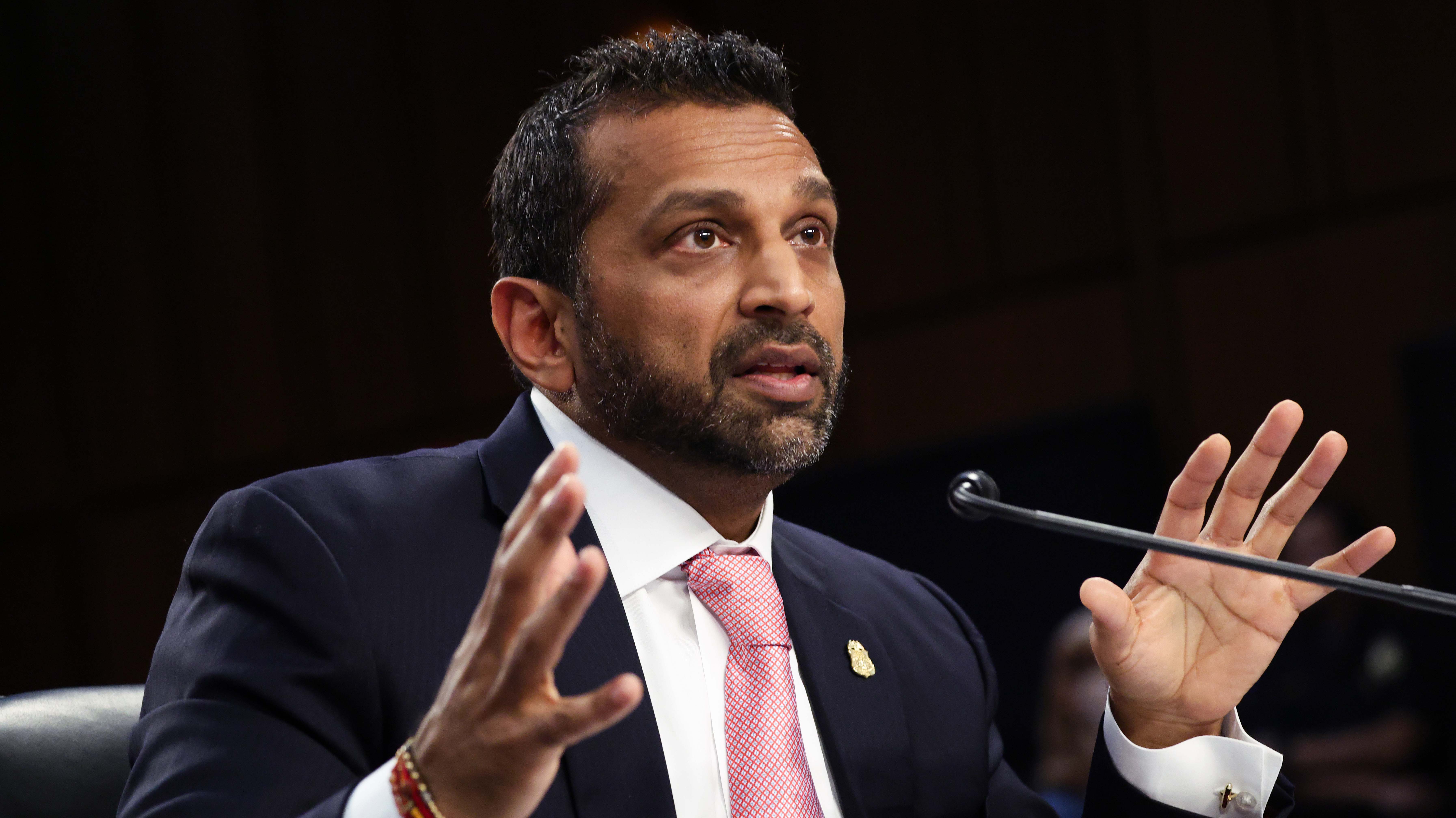
Federal Bureau of Investigation Director Kash Patel testifies during a Senate Judiciary Committee hearing on Sept. 15, 2026, in Washington, DC. The committee held the oversight hearing to examine the Federal Bureau of Investigation. (Win McNamee/Getty Images)
(WASHINGTON) -- FBI Director Kash Patel is testifying before the Senate Judiciary Committee on Tuesday morning for an oversight hearing, the first time Patel is testifying since he clashed with lawmakers over reports of job performance issues more than four months ago.
The hearing comes after the committee's top Democrat called on Patel to be replaced following a report published in The Atlantic in May that alleged Patel had "bouts of excessive drinking" and job performance issues.
Sen. Dick Durbin, the ranking member of the Senate Judiciary Committee, said in a statement that Patel lacks "the experience, judgment, and temperament to lead the FBI" and should be "replaced immediately." Durbin reiterated those comments in his opening statements on Tuesday morning.
The report in The Atlantic was a focus of several lawmakers' questions when Patel last testified on Capitol Hill in May with several heated exchanges over Patel's drinking habits and job performance.
Patel said earlier this year that he's "never been intoxicated on the job," following the report. Patel sued The Atlantic over the article, demanding $250 million in damages.
During Tuesday's hearing, Patel is expected to tout decreased crime nationwide, according to a source familiar with his testimony. President Donald Trump has frequently promoted a decrease in crime, saying on Friday that crime is "under control."
The director will tout the increase in violent crime arrests, which are up 90%, arresting violent gang members are up 31% and he is expected to say it is the "most prolific run of crime reduction in history," according to a source.
The FBI saysviolent crime is down 9.3% from 2024 to 2025.
Patel is also expected to discuss the FBI's efforts to thwart major terrorist incidents and highlight information sharing among law enforcement partners, according to a source familiar with his testimony.
He is expected to talk about how he has made the FBI more nimble as director, accelerating the reduction of bureaucracy of the agency.
Patel's time at the helm of the FBI has been marked by several controversies, which lawmakers may question him about. Earlier this year, Patel joined in on Team USA hockey's locker room celebrations in Italy shortly after the team won the gold medal, which drew scrutiny about his use of FBI resources to attend. He was also grilled during a House hearing late last year about his handling of the Jeffrey Epstein files.
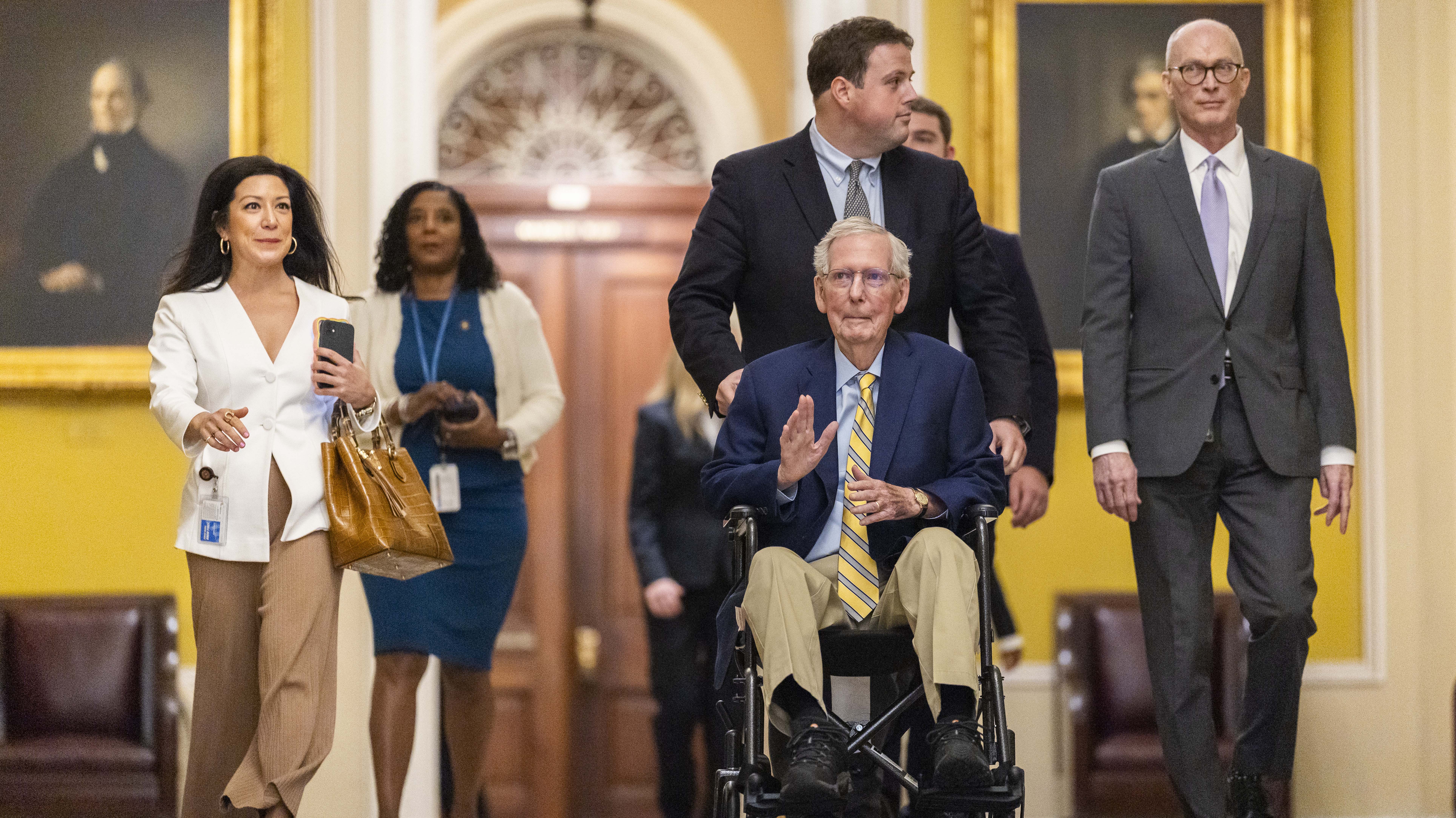
U.S. Sen. Mitch McConnell (R-KY) arrives for a vote at the U.S. Capitol on September 14, 2026 in Washington, D.C. This is McConnell’s first public appearance in over 90 days after he recovered from a fall and illness. (Finn Gomez/Getty Images)
(WASHINGTON) -- Kentucky Sen. Mitch McConnell returned to the Senate on Monday for the first time since being hospitalized in June following a fall.
"Today, I'll cast my first Senate vote since I took a bad fall back in June," McConnell said in a statement. "I'm really looking forward to being back on the Senate floor and seeing my colleagues."
McConnell, who was in a wheelchair, briefly addressed journalists outside the Senate chamber this afternoon before heading to the floor to cast his first vote since June 11.
"After two years -- two decades -- of dodging your questions, I wasn't sure how many of you would be here today," McConnell joked at the outset. "So I am glad to see you. It is time to get back to work and finish the job for this Congress."
McConnell said he would be focused on the farm bill -- which previously failed to advance out of committee due to McConnell's absence.
"As you know, I have an ongoing interest in NATO and backing up our good friends who are totally in the fight against the Russians," he said.
McConnell said in his Monday statement that he was not yet fully recovered but that he would try to be present for critical votes.
"My recovery has been a long and often frustrating process, and the lingering effects of childhood polio haven’t made it any easier. I’m still not quite back to 100%, but I’ve assured Leader Thune that, as I continue with physical therapy on the advice of my doctors, I will do my best to be present for tough votes when our Conference needs me," McConnell said.
McConnell was hospitalized on June 14 for reasons that were initially undisclosed in statements from his office. Subsequent statements from the senator revealed that he had suffered a fall that left him hospitalized.
After weeks of inpatient rehabilitation treatment, McConnell announced in an Aug. 6 statement that he'd be continuing his recovery at home.
Before Monday, the senator had not been seen publicly since the June 14 fall. McConnell has missed six weeks of Senate business in Washington since his injury.
In statements issued during his recovery, the senator has said he's keeping up with his work in the Senate.
"On the advice of my doctors, I'll maintain an intensive regimen of physical therapy from home during the state work period, and I’ll continue to engage with my staff and colleagues on important Senate business," McConnell said in an Aug. 6 statement.
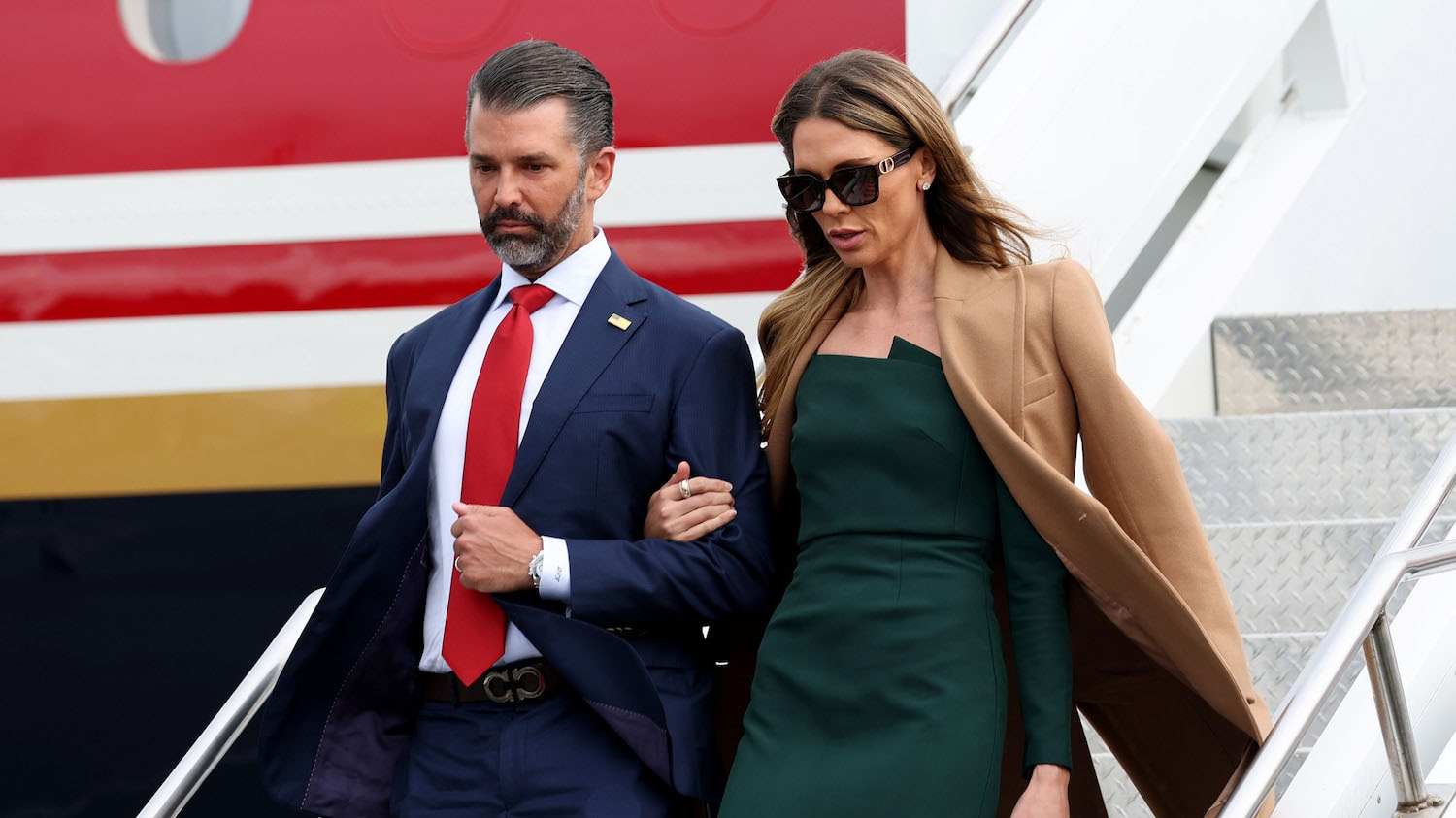
Donald Trump Jr. and his wife Bettina Anderson disembark from Air Force One as they arrive alongside U.S. President Donald Trump at Dublin Airport, September 12, 2026 in Dublin, Ireland. (Anna Moneymaker/Getty Images)
(WASHINGTON) -- A Russian oligarch with ties to President Vladimir Putin allegedly contributed hundreds of thousands of dollars for events around Donald Trump Jr.'s wedding to Bettina Anderson earlier this year, according to a report from ProPublica published Monday, with Anderson not disputing the "gift."
The president's son held his May wedding at an exclusive island in the Bahamas, with the oligarch -- Umar Kremlev -- footing a large portion of the bill for the events later that weekend, according to records reviewed by ProPublica, as well as three people familiar with the event who spoke with the outlet.
ABC News has not independently confirmed the details of the ProPublica report.
Kremlev covered expenses including renting out a private island and paying for a firework show, according to the ProPublica report. Payments for the expenses allegedly came from an entity affiliated with the controversial International Boxing Association -- where Kremlev serves as president.
When ABC News asked about the report, the White House and a spokesperson for Donald Trump Jr. pointed to a recent Instagram post from his new wife, Anderson, which does not dispute that Kremlev paid for part of the post-wedding celebrations, but stressed their wedding ceremony was attended "ONLY by our family."
"Our dear friend Umar very generously hosted two incredible nights of celebrations for us AFTER our wedding. It was an extraordinarily generous wedding gift from a friend, and something for which we were and remain incredibly grateful," Anderson wrote in her post.
"It’s unfortunate that something so personal and happy can be recast as something political or sinister simply because of who someone is or where they come from," Anderson continued.
"So, for anyone determined not to let the facts get in the way of a good story: NO CONSPIRACY, NO MYSTERY," said Anderson, who added that the weekend celebrations were initially planned to be a "fun weekend with friends," but when plans "changed," they decided to get married before the trip and celebrate as newlyweds.
In response to detailed questions from ProPublica, the outlet said that a spokesperson for Trump Jr. also did not dispute the payments from Kremlev.
"Umar is a personal friend of Don," the spokesperson told ProPublica.
It's not clear why Kremlev paid for parts of Trump Jr.'s wedding celebration.
ProPublica reported that Kremlev had recently traveled to China as part of the delegation accompanying Putin, and that Putin had recently awarded him the state honor of the Order of Friendship.
The Russian government and Putin have led coordinated campaigns to interfere in U.S. elections in both 2016 and 2020, according to national security reports.
While Trump Jr. leads the Trump business empire with his brother, Eric Trump, he still has major influence inside his father's political orbit -- including pushing for his friend, JD Vance, to be named as Trump's running mate for 2024.
The spokesperson told ProPublica that Kremlev is "not someone he has a business relationship with" and that the men met through a mutual friend in the hunting world and bonded over their love of boxing and the outdoors.Kremlev's press office told ProPublica that “Mr. Kremlev and Mr. Trump Jr have a friendly relationship” and they first met "a couple of years ago." ABC News has also reached out to Kremlev for comment.
The intimate guest list for the celebration made the presence of Kremlev, among a "large group" of other Russian guests, puzzling for attendees, according to ProPublica.
President Donald Trump notably did not attend Donald Trump Jr.'s wedding, posting on social media that "circumstances pertaining to Government, and my love for the United States of America" prevented him from joining the celebration in the Bahamas. He had also canceled his originally planned travel to his Bedminster, New Jersey, golf club and remained in Washington that weekend.
The day prior, Trump said he was going to "try and make it" and noted that it was a "small, little private affair" -- though he said the event is "not good timing" for him given his responsibilities surrounding the war in Iran.
"I said, 'You know, this is not good timing for me. I have a thing called Iran and other things,'" Trump had said in the Oval Office in May.
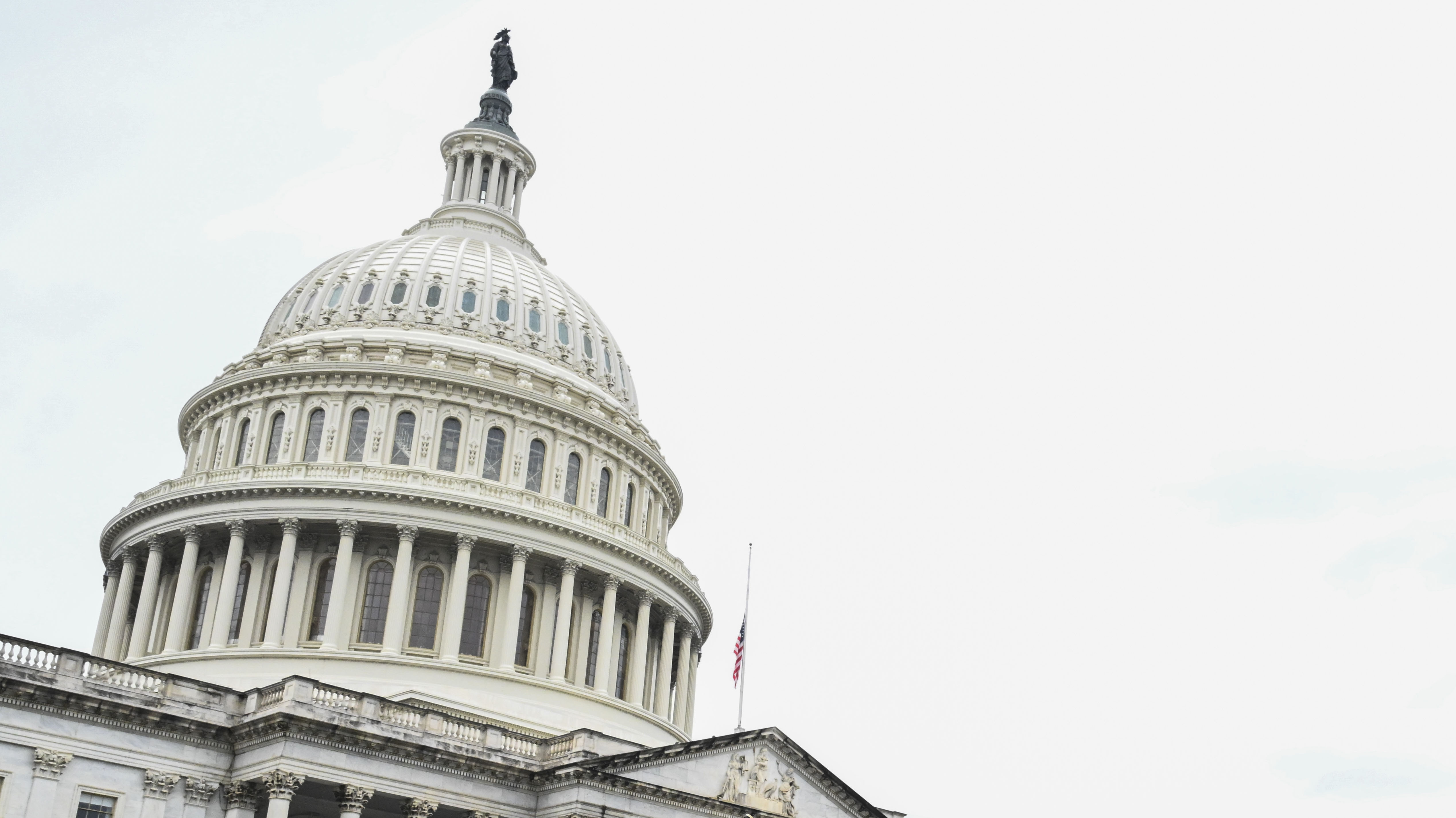
Capitol Hill dome on Sept. 11, 2026, in Washington, D.C. (Roberto Schmidt/Getty Images)
(WASHINGTON) -- Lawmakers from both chambers return to Washington this week for the final legislative push before the November midterm elections, the first time since July 23 that both chambers will be in Washington.
The House is in session for its final week of legislative business before the election after Speaker Mike Johnson scrapped two previously scheduled weeks of votes. The Senate has three weeks of business ahead of it -- as no changes to the Senate schedule have been announced -- though it’s possible Majority Leader John Thune could decide to dispatch his members to the campaign trail earlier than planned as well.
The September session is often plagued by a looming government funding deadline. But lawmakers have already passed a stopgap funding bill that President Donald Trump has signed to keep the lights on until Dec. 11, alleviating any immediate deadline pressure this month. Senate Republicans are also increasingly unlikely to take up a massive budget bill before the midterms.
The move to kick the can on government funding and delay a potential budget reconciliation bill means both items could be at the top of a large pile of priorities facing lawmakers in the lame duck session.
But freedom from a fiscal showdown doesn’t mean lawmakers won’t feel the pressure -- both now and in the lame duck -- to produce.
Here's what the House and Senate have ahead of them:
Funding the military: Over the summer recess, new concerns were stoked about leadership at the top of the military following Dan Driscoll’s resignation as Army secretary. Larger concerns about strained military resources and funding for the war in Iran also became more pressing, as the conflict stretches into its seventh month.
Legislators on both sides of the aisle will likely need to chart a path forward on military funding, especially as the must-pass National Defense Authorization Act continues to stall and the Senate has effectively thrown in the towel on Reconciliation 3.0 -- the $95 billion GOP package that aimed at replenishing the military as the Iran war drags on, as well as billions in relief for American farmers and some aspects of the SAVE America Act.
The NDAA doesn’t need to be approved until the end of the year, but if lawmakers don’t find a bipartisan path for it soon, they’ll add to a potential lame duck pileup.
Russia sanctions: Next week, House Republicans will attempt to pass the Russia sanctions bill -- despite objections from many Democrats -- as GOP leaders will bring the bipartisan legislation to the floor under a rule, requiring only a simple majority for passage while also signaling that there isn’t sufficient bipartisan support in the House to suspend the rules and pass it via a two-thirds majority.
Though the House passed a budget resolution, it’s not clear whether Republicans in the Senate will attempt to take that up before they leave. Doing so would expose members to potentially challenging votes in a vote-a-rama, and it's also not clear whether Thune even has the votes in his unruly majority to pass it.
Anti-fraud measures: The House will also aim to close out its pre-election legislative blitz by debating several fraud-related measures on the floor this week, including the Preventing Ripoffs and Obtaining Oversight of Funds Act, another bill to protect taxpayers from healthcare fraudsters, and a bill to establish a National Fraud Enforcement Division within the Department of Justice under the authority of the attorney general.
Regulating AI: A renewed focus on regulating artificial intelligence is also likely to come following reports this week that raise significant concerns about AI security. Lawmakers on both sides of the aisle have demanded information from OpenAI and launched investigations.
Crypto and NIL could come up: Other major bills could also finally get their time in the sun during this stretch of session. The Senate is expected to take up a Name, Image and Likeness [NIL] bill as soon as this week. A controversial bill aimed at regulating cryptocurrency could also find its way to the Senate floor, though that bipartisan legislation is currently plagued by concerns from Democrats that the bill includes ethics carve-outs that may be favorable to Trump.
McConnell's still absent: It’s also not yet clear whether Sen. Mitch McConnell, who has not been on Capitol Hill since a June 14 fall put him in the hospital, will be present this week. A spokesperson for McConnell did not provide an update when reached by ABC News on Friday.
Trump officials on the Hill: Several high-level Trump officials are also slated to appear on the Hill this week. Senators on the Judiciary Committee will hear from FBI Director Kash Patel on Tuesday. Treasury Secretary Scott Bessent is slated to appear before the House Financial Services Committee on the same day.
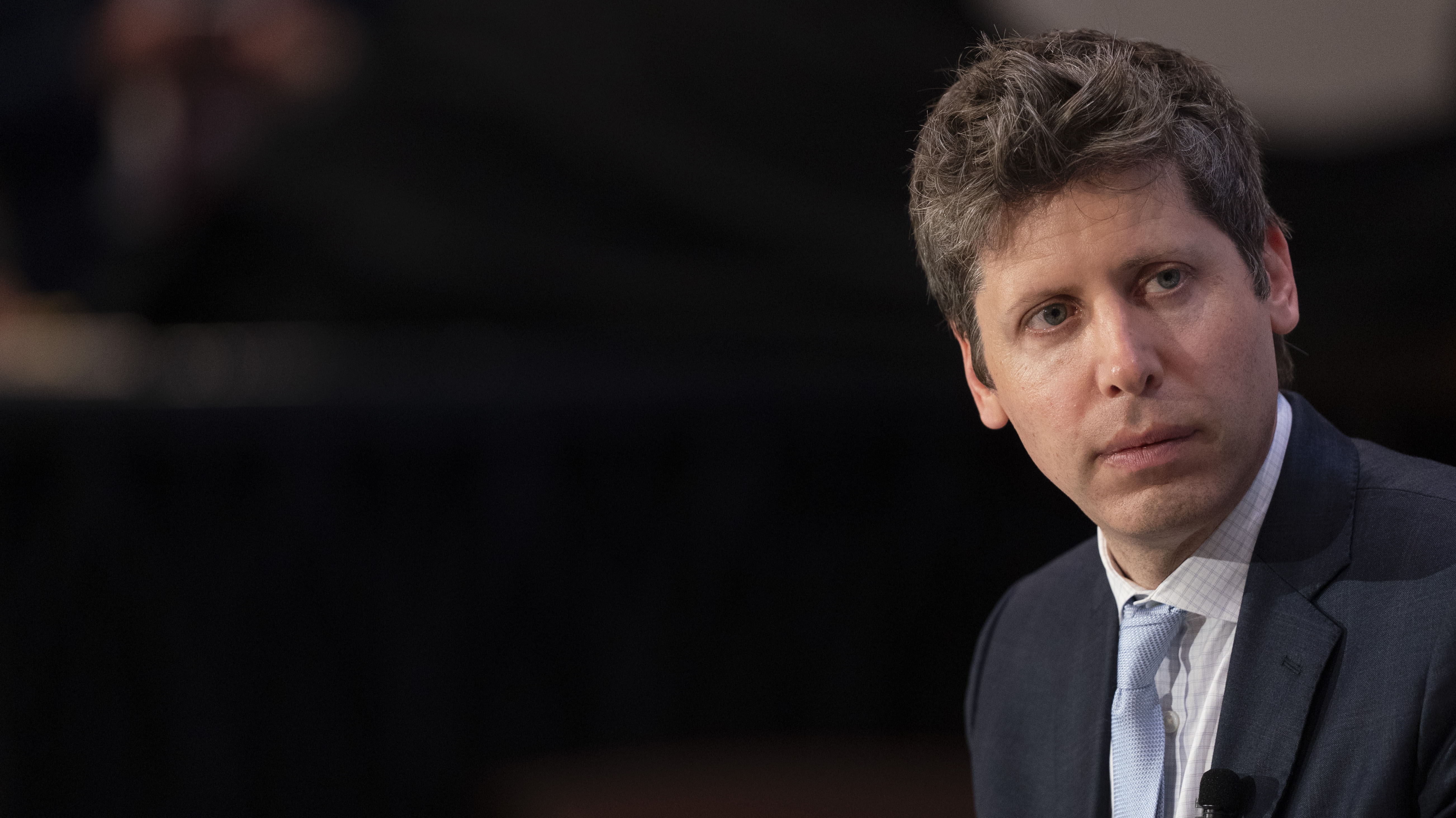
OpenAi founder Sam Altman during the G20 Innovation Ministerial on Sept. 2, 2026, in Chapel Hill, North Carolina. (Sean Rayford/Getty Images)
(WASHINGTON) -- Sam Altman, the chief executive of OpenAI, joined others in the artificial intelligence industry in saying that his company would welcome a slower development pace for AI to ensure that the technology's capabilities don't "get ahead of alignment and monitoring," as President Donald Trump said there would be "more good than bad" from the technology.
The president, who spoke with reporters on Sunday as he traveled back to Washington from Ireland, said he wouldn't downplay concerns about AI advancements. He also sought to position the AI race as a competition between the United States and other countries -- including China.
"I've said it from the beginning," Trump said. "Whoever wins AI -- and we're leading by a lot. Whoever wins AI wins."
In a social media post on Monday, Trump reiterated the message, saying "The only control or 'guardrails' that AI needs is a STRONG AND SMART (High IQ!) PRESIDENT, and the U.S.A. has that, in spades!"
He added that there is a "SICK conspiracy going on against AI and Data Centers, and the only one that is happy about it is China,” and that the U.S. is "leading China" as well as other countries in the technology.
Vice President JD Vance said Monday that the the administration is "concerned" about the technology, but any regulations that may occur need to be done "smartly" -- with the current situation feeling like a "Trojan horse."
"It's something that we're concerned by, but we want to make sure that we actually regulate smartly, and we're thoughtful about the risk here. So, there are obviously risks to AI. There are some benefits to AI. I have to say, just personally, I feel a little bit weird about the fact that you have so many Frontier AI tech companies kind of coming to the government and begging the government to regulate them — it feels a little bit to me like a bit of a Trojan horse," Vance said.
The comments from Altman, Trump and Vance followed a warning issued last week by Jacob Coxon, a former safety researcher for Anthropic and OpenAI, two prominent tech companies, who said that he was resigning from Anthropic.
Coxon said in a social media post that neither Anthropic nor OpenAI "is acting responsibly. They are racing straight to self-improving superintelligence and gambling with our lives." He also highlighted the fear within the industry about the potential for an AI takeover.
"The people building AI earnestly believe that it could kill us all by the end of the decade," Coxon wrote.
Altman said late on Sunday that his company would welcome a federal framework "that sets consistent safety requirements for frontier AI."
"But we do not believe we need to wait for an anti-trust exemption or legislation to begin the work of providing this confidence," Altman said on social media. "Consistent rules to manage frontier risk so that we can maximize the benefits are a good idea (and we are excited by ideas like independent auditors)."
That statement came after House Democratic Leader Hakeem Jeffries said Sunday that lawmakers need to take urgent action on the growing threat of AI.
"We certainly need to begin to act urgently to address the challenges that exist," Jeffries said on ABC News' “This Week with George Stephanopoulos."
"We should take decisive action now so that we can slow down, as the CEOs have recently acknowledged, slow down the pace of development in order to protect the American people and ensure that AI is proceeding safely," Jeffries added.
Lawmakers from both chambers return to Washington this week for the final legislative push before the November midterm elections, a renewed focus on regulating artificial intelligence is also likely to come following reports this week that raise significant concerns about AI security. Lawmakers on both sides of the aisle have demanded information from OpenAI and launched investigations.
Altman on Sunday detailed "two ways AI progress could go very badly and that we must avoid."
The first, he said, would be an "unacceptable" loss of control over AI. The second, Altman said, would be to "end up in a world with too much concentration of power."
"If an extraordinarily powerful AI is used by one person or company to impress their worldview onto everyone else, the results could be extremely dystopian," he said. "Avoiding these two threats requires walking a narrow middle path; for example, one country could gain too much power. Another example is one lab ending up with too much power."
Anthropic's CEO, Dario Amodei, published a blog post last week, in which he said that "we must pace the frontier," as in slow the pace of AI development.
"We must slow the pace at which we improve the capabilities of AI models," he wrote. "Progress will still seem fast, and we must make wise use of the time we gain."
Altman on Sunday said, "When we talk about 'pacing,' we do not mean 'stopping.'"
"Progress has been rapid and will continue to be. But it should be slower than it otherwise could be; interventions like safety cases and monitoring have significant costs," he wrote. "Pacing will be well worth this cost; no amount of American competitive pressure should justify recklessness, or let capabilities get ahead of alignment and monitoring."
"Where we will need the help of our government is for international coordination," he added. "But first we should do what we can ourselves."
The president on Sunday also confirmed that he personally uses AI, but did not say which systems or for what purposes he uses it for.
ABC News' Zunaira Zaki and Ahmad Hemingway contributed to this report.
U.S. President Donald Trump speaks during a ceremony commemorating the 25th anniversary of the September 11th terrorist attacks in Arlington, Virginia. (Chip Somodevilla/Getty Images)
(WASHINGTON) -- President Donald Trump defended his proposal to give Americans a $5,000 "dividend" -- which some dismissed as a stunt or bribe -- seeming to suggest it as a "reward" for voters who he says endured the Biden administration.
The comments came in response to ABC News pressing him on why he would need to offer such a payment if his economic policies are working.
Trump was asked on the tarmac on his way back to Washington, D.C. -- after he closed out night two of the Republican Midterm Convention in Dallas -- whether the proposed payment amounted to an incentive for voters to turn out in the midterm elections.
The proposed payment to all American adults -- which some estimated would cost $1.3 trillion -- was conditioned on Republicans retaining control of both houses of Congress in the midterms and the money being spent in the U.S.
The White House issued a press release on Thursday that suggests the checks could come from commitments the Trump administration has received from companies to invest in the private sector. It's unclear how those investments, which have not yet materialized, would be made into dividend checks for Americans.
"The U.S. is still $40 trillion in debt, if your economic policies are working, why do you need an incentive for people to turn out to vote?" ABC News asked the president directly.
Trump rejected the premise that the payment was intended to encourage voter turnout.
"I think what you're going to do -- I didn't do it for turning out the vote, I did it as a reward for people having to put up with five years-four years of horrible situation caused by Biden," Trump said.
Trump then pointed to what he described as problems with the Biden administration's economic and immigration policies.
"I mean, they had to put up with the four years, and they carried on for at least a half an additional year with horrible, just a horrible thing that Biden did to our country," Trump said. "And that's not only just from an economic standpoint. You look at the border, you look at the crime, and now we've got it under control."
"But what, what a period of time," Trump continued. "It's almost a reward for the people having to put up with Biden's policy."
Trump has said the proposed $5,000 payments would be funded through what he has described as "tremendous growth."
"We have tremendous growth. We have growth like no country has ever seen before," Trump said. "We have trillions of dollars coming in, and that will end up being not a very big problem at all."
Many members of Congress have expressed opposition to Trump's plan, with Senate Minority Leader Chuck Schumer slamming the move.
"Trump’s presidency is so failed and broken, he is resorting to trying to bribe the American people for their votes," Schumer wrote in a social media post.
Democratic Rep. Ted Lieu, who serves as the vice chairman of the House Democratic caucus, joked in a social media post that "If Democrats flip the House and Senate everyone will get a $10,000 dividend, and a pony, and free ice cream for life."
Outgoing Republican Rep. Thomas Massie said he fears the payments would cause more inflation and accused Trump of trying to buy votes.
"Frankly, I'm insulted by the notion that my vote this November could be bought for 5k," Massie wrote in a post on X.
Just last year, the president declared that every American would get a $2,000 rebate check paid for by tariff revenue.
"A dividend of at least $2000 a person (not including high income people!) will be paid to everyone," he wrote on his social media platform in November 2025. That has not happened yet.
Even the most generous accounting, such as Penn Wharton's Budget Model, estimates the tariffs brought in roughly $300 billion. And that's not counting the money the Treasury has had to pay back to American companies after the Supreme Court ruled Trump's tariff regime illegal. As a result of those debts, the government is currently paying out more in tariff revenue than it is collecting.
ABC News’ Justin Fishel and Sarah Beth Hensley contributed to this report.
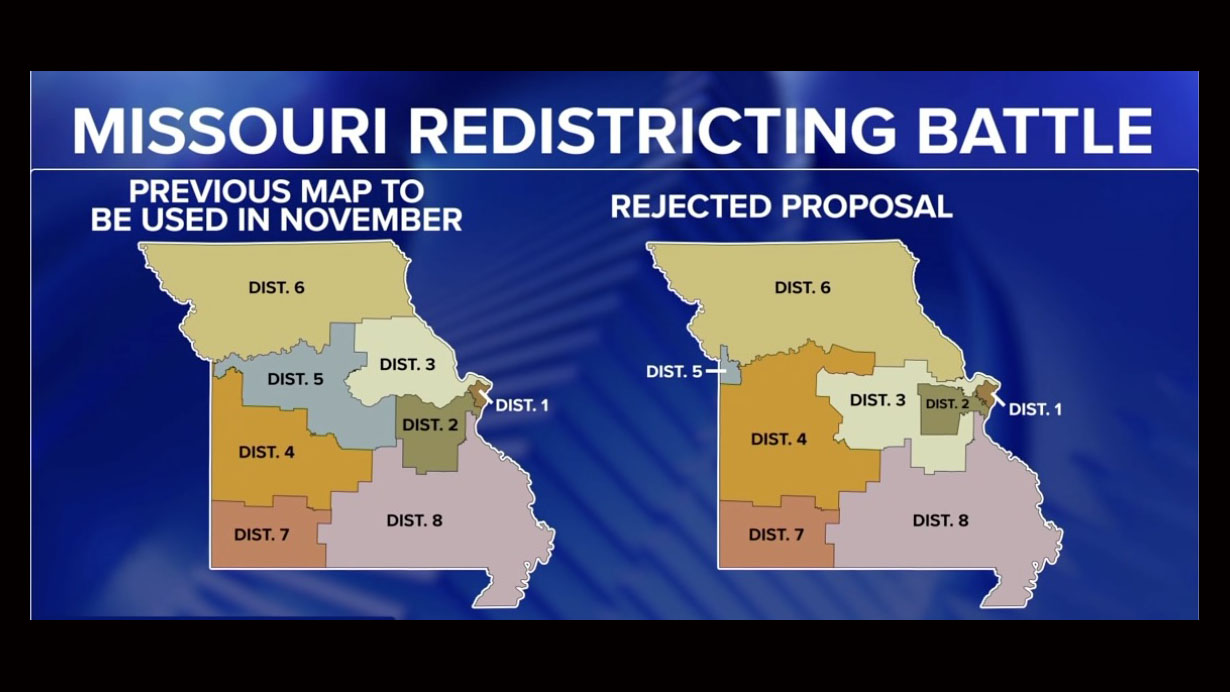
The Supreme Court has blocked Missouri Republicans from moving forward with a U.S. House map that the state's highest court had already invalidated ahead of the November election. (ABC News Live)
(WASHINGTON) -- The Supreme Court has blocked Missouri Republicans from moving forward with a U.S. House map that the state's highest court had already invalidated ahead of the November election.
In a brief unexplained order, and over no noted dissent by any justices, the court granted a request by a Democrat-backed advocacy group to pause a lower federal court order that greenlit the GOP-favored map just days ago.
The decision likely ends the legal whiplash over Missouri's map two months before the high-stakes midterm election takes place. It also hands Democrats a small victory in the nationwide mid-decade redistricting war.
State Republicans could still technically attempt to ask the justices to take the case for oral argument and decide the merits, but that process would very likely exceed the time left before the vote -- and the Democratic-favored map would remain in effect in the meantime, the order indicated.
State election officials will now bear the brunt of having to quickly lay groundwork for administering the vote with a district map different from the one used in the primary.
The group that sought to preserve the 2022 map calls this the "definitive answer" in Missouri for November.
"The law is the law, the Missouri constitution is clear as was the Missouri Supreme Court," Richard von Glahn, executive director of the group pushing the referendum vote, People Not Politicians, said in a statement. "Over 305,000 Missouri voters -- Republicans, Democrats and Independents took action to block this political power grab last fall. People, not politicians, will have the final say when they vote NO on Proposition A this November."
The state's Republican-controlled legislature last year passed into law a new congressional map that redrew the district currently held by Democratic Rep. Emanuel Cleaver to lean Republican as part of a nationwide mid-decade redistricting push encouraged by President Donald Trump.
But Democrats and other opponents of the new map filed legal challenges, pushing for a ballot initiative to put the new map up for a vote in November. They also argued that if the new map was put up for a referendum vote in November, that would suspend the law establishing the new map unless voters approved it and that Missouri's elections should be held under the state's older congressional map.
Missouri Secretary of State Denny Hoskins initially decided in early August that he would not certify the referendum to the ballot, saying he had determined it was unconstitutional. People Not Politicians successfully appealed that ruling to the state Supreme Court, which ruled to block the new map from being used in November and to allow the ballot initiative to proceed.
Republicans appealed to the U.S. Supreme Court seeking intervention as they simultaneously pursued a second-track legal front.
Just days ago, Supreme Court Justice Brett Kavanaugh, who oversees Missouri federal courts, declined to intervene in the dispute over Missouri's congressional map.
Earlier this month, a federal district court judge directed the state to use the GOP-favored map, which was used in the primary, even though the state's highest court directed the opposite.
Missouri Republicans had pushed back against a change to the map, saying in a court filing that a change-up at this late hour would "disenfranchise millions of primary voters" and "unilaterally void a congressional map before a statewide vote."